
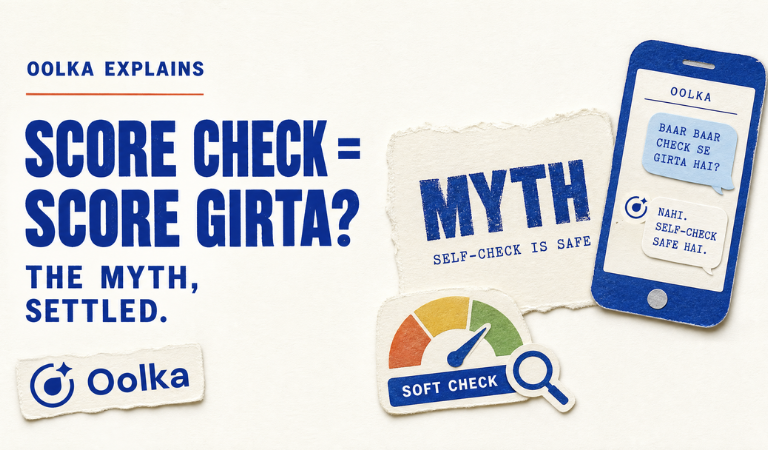
Checking your credit score does not lower it when you do it yourself through official or authorised platforms.
You might be under the assumption that your credit score reduces every time you check it, but that only applies to hard enquiries made by lenders, not personal checks.
Kaushal, 32, from Delhi, checked his credit score three times in a week before applying for a personal loan. He assumed the repeated checks might reduce his score, so he stopped checking altogether.
When his loan was rejected later, he believed his score had dropped because of those checks.
The actual reason had nothing to do with checking frequency.
Understanding how enquiries work is important because banks like HDFC, SBI, ICICI, Axis Bank, and NBFCs like Bajaj Finserv or Tata Capital evaluate enquiry behaviour during loan approvals.
What Happens When You Check Your Credit Score?
A credit score is a 3-digit number ranging from 300 to 900 that reflects your credit behaviour. It is calculated based on repayment history, credit utilisation, loan mix, credit age, and enquiries.
When you check your own score using a soft inquiry, it does not affect your credit profile.
However, when a bank checks your report for loan approval, it is recorded as a hard inquiry.
Credit factor weightage:
- Payment history: 35%
- Credit utilisation: 30%
- Credit age: 15%
- Credit mix: 10%
- Enquiries: 10%
Score bands:
- 300–549: High risk
- 550–649: Moderate risk
- 650–749: Good profile
- 750+: Strong approval range
Checking your own score falls under monitoring, not lending activity.
Does Checking Credit Score Reduce It?
No, checking your own credit score does not reduce it.
The myth comes from misunderstanding enquiry types.
Soft enquiry:
- Done by you
- Visible only to you
- No score impact
Hard enquiry:
- Done by banks/NBFCs
- Happens during loan/card application
- Slight temporary impact possible
If you check your score frequently using platforms like official credit bureaus or authorised apps, there is no penalty.
The real risk comes from multiple loan applications in a short period.
What Is The Impact Of Multiple Loan Applications?
When you apply for loans repeatedly, each lender performs a hard inquiry.
Impact depends on:
- Existing credit score
- Number of recent enquiries
- Loan type
- Overall credit behaviour
Typically, one hard inquiry may have a minor impact, but multiple enquiries in 30–60 days signal credit hunger.
Example:
- 1 inquiry – negligible impact
- 3–5 inquiries -moderate score drop risk
- 6+ inquiries – approval probability reduces
This is why lenders in India prefer stable enquiry patterns before approving personal loans or credit cards.
Soft Inquiry Vs Hard Inquiry:
| Type | Who Initiates | Effect On Score | Visibility |
| Soft Inquiry | Self-check / monitoring apps | No impact | Only user |
| Hard Inquiry | Bank/NBFC | May slightly reduce score | All lenders |
Can Frequent Checking Improve Credit Awareness?
Yes. Checking your score regularly helps track credit health but does not directly increase score.
This is where users search how to increase credit score, but score improvement depends on repayment behaviour, not checking frequency.
Ways to improve score:
- Pay EMIs on time
- Keep utilisation below 30%
- Avoid multiple loan applications
- Maintain old credit accounts
- Limit unsecured borrowing
A strong credit profile usually takes 2–3 years of consistent repayment discipline.
Regular monitoring helps you catch:
- Sudden score drops
- Wrong reporting
- Fraudulent activity
- Unusual enquiries
Oolka challenges incorrect or excessive enquiry entries with lender-specific dispute submissions, raises correction requests for overlapping loan applications, and pushes resolution requests until the enquiry records are updated in the credit report.
Also Read: Unknown Credit Enquiry in Credit Report? Here’s What to Do
Real Story: Too Many Loan Applications Caused Confusion
Bharat, 29, from Pune, applied for a personal loan at 3 different banks within 10 days.
Profile:
- Salary: Rs. 65,000
- Credit score: 742
- No missed EMIs
Still, approvals slowed down.
Reason: Multiple hard enquiries.
What happened next:
- Oolka filed dispute clarification requests where enquiries were linked to duplicate loan attempts
- It drafted lender communication explaining overlapping applications
- It submitted structured correction requests for enquiry review
- It pushed resolution until enquiry mapping was clarified in the report
The issue was not repayment history. It was enquiry frequency in a short time.
Does A Loan Rejection Affect Your Credit Score?
Loan rejection itself does not directly reduce your credit score.
However, rejection often happens due to:
- High enquiries
- Low income-to-loan ratio
- Existing credit utilisation
Users often assume rejection lowers score, but it is the enquiry that causes minor impact, not rejection status.
Can You Remove Hard Enquiries?
Hard enquiries cannot be removed unless they are incorrect or unauthorised.
If there is an error:
- Raise a dispute
- Contact the lender
- Provide supporting documentation
Valid enquiries remain in the report for up to 2 years.
Credit Score Impact Calculator (Understanding Pattern)
There is no fixed calculator for enquiry impact, but lenders evaluate:
- Inquiry frequency
- Credit utilisation
- Repayment consistency
- Loan type applied
General pattern:
- 750+ score + low enquiries – high approval probability
- 650–749 + moderate enquiries – conditional approval
- Below 650 + high enquiries – high rejection risk
This is why users search credit score impact calculator, but lenders rely on behavioural scoring, not fixed numbers.
How To Check Your Credit Score Safely
You can use:
- Official credit website
- Bank apps
- RBI-approved financial platforms
Search terms like check credit score free are common, but ensure the source is authorised.
Always verify:
- No repeated loan applications
- No unnecessary hard enquiries
- No fake “score boost” promises
Oolka acts on enquiry-related issues in your credit report by filing disputes, sending objection emails, and pushing for resolution until incorrect or excessive enquiries are corrected in the report.
The Bottom Line: Does Checking Your Credit Score Lower It?
Checking your own credit score does not reduce it.
Only lender-initiated hard enquiries during loan or credit applications can impact your score slightly.
Most score drops happen due to multiple loan applications, high credit utilisation, and missed repayments.
Regular monitoring is safe and recommended for financial awareness. If you want to stay ahead of credit issues, check your report regularly and act early on changes.
Also Read: What is a Credit Mix and How Can it Affect Credit Scores?
FAQs
1. Does checking credit score multiple times reduce it?
No, checking your own credit score multiple times does not reduce it. These are soft enquiries and are not visible to lenders. Only hard enquiries made by banks or NBFCs during loan or credit applications can have a minor impact on your score.
2. How do I check my credit score for free?
You can check your credit score for free through credit bureaus like Experian.in or authorised banking apps. You will need PAN, mobile number, and email ID for verification.
3. Should I Check My credit Score If I Don’t Require Credit?
Yes, it is still useful even if you are not planning to take credit. Regular checks help you understand your credit health, track changes, and identify errors or unauthorised activity early before they affect loan eligibility.
4. How long do hard inquiries remain on my credit report?
Hard enquiries usually stay in your credit report for up to 24 months. Their impact reduces over time, but lenders can still view them during loan or credit card evaluations.
5. Can I remove a hard inquiry from my credit report?
Valid hard enquiries cannot be removed. If an enquiry is incorrect or unauthorised, you can raise a dispute with the credit bureau or the concerned lender for correction after verification.
6. How many points does a hard inquiry reduce from my credit score?
There is no fixed number of points deducted for a hard inquiry. The impact depends on your credit profile, existing score, repayment history, and number of recent enquiries.
7. Why is my credit score not increasing even after timely payments?
Even with timely payments, score improvement may be slow due to high credit utilisation, recent enquiries, or limited credit history. Credit scores respond gradually to behavioural changes.
8. Does a loan rejection impact my credit score?
No, loan rejection does not directly affect your credit score. However, the hard enquiry made during the application remains in your report and may influence future lending decisions.
9. When should I check my credit score?
It is recommended to check your credit score every 2–3 months or before applying for any loan or credit product. This helps you stay updated and avoid surprises during approval.
10. What should I do if my credit score suddenly drops?
If your score drops suddenly, check for missed payments, increased credit utilisation, or new enquiries. Identifying the cause early helps you take corrective action and prevent further decline.