
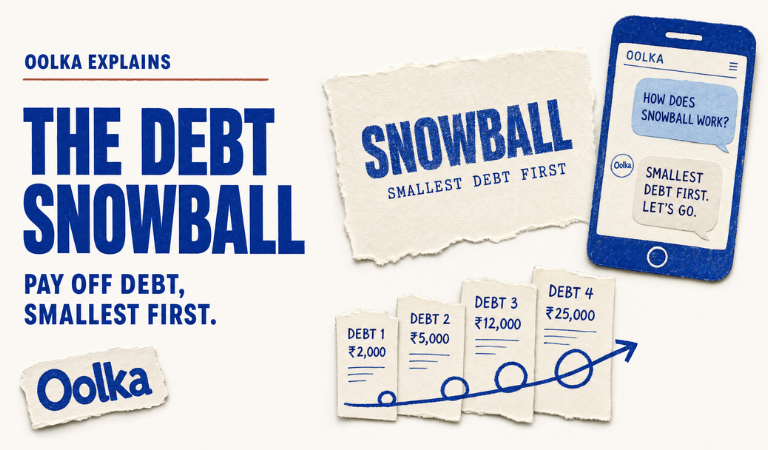
The debt snowball strategy is a debt repayment method where you pay off the smallest outstanding debt first while continuing the minimum payment on every other loan. As each balance is cleared, that payment is added to the next debt, helping you repay larger loans faster over time.
Nitin, 35, from Indore, was managing a Rs.22,000 credit card balance, a Rs.95,000 consumer loan, and a Rs.4.8 lakh personal loan. Every EMI was paid on time, but handling multiple repayments each month had become stressful.
Instead of dividing every extra rupee across all his loans, he focused on closing the smallest balance first. Within a few months, one repayment disappeared completely, making it easier to manage the remaining loans without increasing his monthly budget.
The strategy does not reduce your debt overnight. It simply gives you a structured repayment plan that becomes easier to maintain as each loan is closed.
What Is A Snowball Method?
A snowball method is a repayment strategy that prioritises the smallest outstanding debt before moving to larger balances. You continue making the minimum payment on every loan, but any extra money goes towards the smallest balance until it is fully repaid.
If you’re wondering what is a snowball method, the answer is simple: it helps reduce the number of active debts as quickly as possible. Instead of spreading extra payments across multiple loans, the strategy concentrates them on one account at a time. Once that debt is cleared, the monthly amount previously used for it is added to the next smallest loan.
For example, if you have a Rs.20,000 credit card balance, a Rs.75,000 consumer loan, and a Rs.4 lakh personal loan, the additional repayment always goes towards the Rs.20,000 balance first. After it is closed, the same amount is redirected to the Rs.75,000 loan, followed by the personal loan.
The idea is to build repayment momentum by eliminating individual debts one after another.
How Does The Debt Snowball Method Work?
The debt snowball method follows a fixed repayment sequence based on outstanding balance rather than interest rate. Every loan continues to receive its minimum payment, while all additional repayments are directed towards the smallest debt.
The process works like this:
- List every outstanding debt from the smallest balance to the largest.
- Continue paying the minimum amount due on every loan.
- Put every extra payment towards the smallest balance.
- Close that loan completely.
- Roll the previous monthly payment into the next smallest debt.
- Repeat the same process until every loan is repaid.
As each account is closed, the amount available for the next repayment increases automatically. This creates the “snowball” effect that gives the strategy its name. Although it may not always minimise total interest costs, borrowers find it easier to follow because they see visible progress much earlier.
Also Read: How Loan Settlements Affect Your Credit Score
Why Do Borrowers Prefer This Strategy?
The debt snowball strategy is driven by momentum rather than mathematics. Some repayment strategies focus on reducing interest costs first, but they may take much longer before a borrower completely clears even one loan.
With the snowball strategy, the first repayment milestone often arrives within a few months. That visible progress encourages borrowers to continue making additional repayments instead of returning to minimum payments alone.
Borrowers often choose this approach because it:
- Reduces the number of active loans more quickly.
- Makes monthly repayments easier to organise.
- Creates clear milestones throughout repayment.
- Builds confidence after each loan is closed.
- Simplifies debt management without increasing the monthly budget.
For people managing several small unsecured loans, reducing the number of active repayments can make monthly finances feel much more manageable.
Is The Snowball Strategy Right For You?
The debt snowball strategy is suitable for borrowers who struggle with managing multiple debts and want a structured repayment plan with regular milestones. It may not always save the most interest, but it often makes it easier to stay committed over the entire repayment period.
Before choosing this approach, compare your outstanding balances, interest rates, and monthly budget.
| Factor | Debt Snowball Strategy |
| Repayment priority | Smallest outstanding balance first |
| Main objective | Close individual debts quickly |
| Best suited for | Borrowers with multiple small debts |
| Biggest advantage | Builds motivation through early wins |
| Main limitation | May result in higher overall interest than some alternatives |
The strategy works best when you continue making every scheduled payment on time and avoid taking new debt while repaying existing loans. Consistency is what ultimately determines whether the method succeeds.
Is The Debt Snowball Better Than Loan Settlement?
The debt snowball strategy and loan settlement are designed for different financial situations. The snowball approach helps borrowers who can continue repaying their loans, while settlement is considered when repaying the full outstanding amount is no longer possible.
The main difference is straightforward:
- The snowball strategy focuses on repaying every debt in full.
- Loan settlement involves negotiating with the lender to close the loan for less than the total outstanding amount.
- The snowball method aims to reduce the number of active debts over time.
- Settlement can affect your credit history because the loan is not repaid according to the original agreement.
If your income allows regular EMI payments, the snowball strategy is the better long-term approach. Settlement should be considered only after understanding its financial and credit-related consequences.
Before you decide which debt to repay first, let Oolka do the groundwork. It files the dispute, drafts the lender objection, and chases the correction so you can move ahead with confidence.
Can The Snowball Strategy Help Improve Your Credit Profile?
Following the snowball strategy can support better repayment habits, but it does not improve your credit score immediately. The biggest benefit comes from making every payment on time while gradually reducing your outstanding debt.
Understanding how to improve credit score involves more than paying off debt. Repayment history, existing debt levels, credit utilisation, and responsible borrowing behaviour all play an important role in future lending decisions.
Along with paying off loans, remember to:
- Pay every EMI before the due date.
- Continue making minimum payments on every active account.
- Avoid applying for unnecessary credit.
- Keep revolving credit balances under control.
- Review your credit report regularly.
A stronger credit profile is normally built over 2 to 3 years of consistent repayment behaviour rather than a few months of extra payments. As you repay each loan, your repayment history is reflected by credit bureaus such as CRIF High Mark, making consistent on-time payments important throughout your debt repayment journey.
How One Incorrect Loan Status Disrupted A Debt Snowball Plan
Ananya, 33, from Nagpur, had a Rs.28,000 credit card balance, a Rs.1.1 lakh consumer loan, and a Rs.3.6 lakh personal loan. She decided to follow the debt snowball strategy by clearing the credit card first before moving to the larger loans. While reviewing her credit report before making extra repayments, she found that a loan she had already closed was still showing an incorrect repayment status.
Instead of asking Ananya to manage the correction herself, Oolka stepped in to remove the issue that could affect her future borrowing plans. It:
- Prepared the dispute request with the supporting repayment documents.
- Drafted the lender clarification email explaining the reporting mismatch.
- Submitted the required information for review.
- Followed up with the lender until the reporting issue was resolved.
With the reporting issue addressed, Ananya continued her debt snowball plan without diverting time to paperwork and lender follow-ups. She stayed focused on clearing one balance at a time instead of managing both repayments and dispute communication simultaneously.
Could Debt Consolidation Be A Better Choice?
The snowball strategy changes the order in which debts are repaid. Debt consolidation in India combines eligible debts into one new loan with a single monthly repayment.
Consolidation may be suitable if:
- Managing several EMIs has become difficult.
- A lower interest rate is available.
- One monthly repayment is easier to manage.
- The new loan reduces the overall repayment burden.
However, consolidation is not automatically the better option. Processing fees, repayment tenure, and total borrowing costs should always be compared before replacing existing loans.
For some borrowers, continuing with the snowball strategy provides a simpler and less expensive solution than taking a new consolidation loan.
Also Read: Loan Rejected Due to Low Credit Score? Here’s What to Do Next
The Bottom Line: Should You Use The Debt Snowball Strategy?
The debt snowball strategy is a practical repayment method for borrowers who want a structured way to clear multiple debts without feeling overwhelmed. By paying off the smallest balance first and rolling that payment into the next loan, the repayment amount grows over time while the number of active debts keeps falling.
The strategy may not always save the most interest, but borrowers find it easier to stay consistent because they see regular progress. If your goal is to simplify repayments and remain committed until every loan is cleared, the snowball approach can be an effective choice.
Start your debt payoff journey with Oolka. From raising disputes to managing lender communication, Oolka takes care of all the work so you can stay focused on becoming debt-free.
FAQs
1. Does the debt snowball method really work?
Yes. It works well for borrowers who stay consistent with repayments and want to reduce the number of active debts quickly. The method builds momentum by closing smaller balances before moving to larger ones.
2. How does the debt snowball work?
You continue making the minimum payment on every loan while directing all extra money towards the smallest outstanding balance. Once that debt is cleared, the same repayment amount is rolled into the next smallest loan.
3. What is the snowball formula?
There is no mathematical formula. The strategy simply follows a repayment sequence where debts are arranged from the smallest balance to the largest and cleared one at a time.
4. What are the 3 biggest strategies for paying down debt?
The three most common approaches are the debt snowball strategy, the debt avalanche strategy, and debt consolidation. Each works differently depending on your repayment capacity and financial goals.
5. How can I pay off my debt fast?
Make every EMI on time, pay more than the minimum amount whenever possible, and avoid taking new debt while repaying existing loans. Following a structured repayment strategy consistently is faster than making irregular extra payments.