
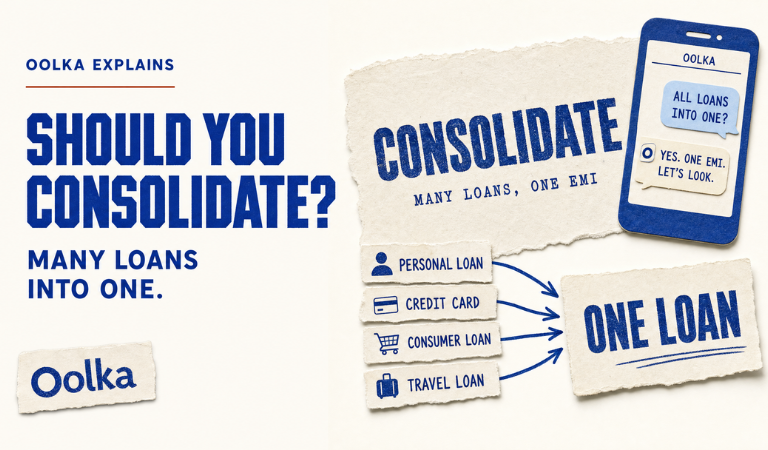
Debt consolidation can simplify repayments, but taking another loan is not always the smartest solution. Negotiating with lenders, reducing penalties, or restructuring existing repayments can lower your monthly burden without increasing your total debt.
Neeraj, 38, from Indore, was repaying two personal loans, three credit cards, and a consumer durable loan. Every month, nearly Rs.62,000 of his Rs.95,000 salary went towards EMIs and minimum card payments. He was ready to apply for another loan until he realised that not every debt problem requires fresh borrowing. A structured repayment strategy often works better than adding another liability.
If you’re juggling multiple repayments, the goal should not be to reduce the EMI at any cost. The goal should be to reduce financial stress while keeping the total repayment under control.
Whether you consolidate your debt or negotiate directly with lenders, your repayment behaviour can continue to influence your credit history maintained by bureaus such as Experian India. This is why the right repayment strategy matters just as much as clearing the debt itself.
What Is Debt Consolidation And How Does It Work?
Debt consolidation combines multiple outstanding debts into a simpler repayment structure. This may involve taking one new loan, restructuring existing repayments, or negotiating revised payment terms with current lenders instead of managing several EMIs every month.
Borrowers ask “how does debt consolidation work” after finding it difficult to track different due dates, interest rates, and repayment schedules.
A typical process looks like this:
- List every outstanding loan and credit card balance.
- Calculate the total monthly repayment.
- Compare interest rates and remaining tenures.
- Evaluate whether a single repayment plan reduces the total borrowing cost.
- Choose the repayment option that creates the lowest long-term financial burden.
Debt consolidation is not about replacing one problem with another. The objective is to simplify repayments without paying significantly more interest over the loan’s entire tenure. Always compare processing charges, foreclosure costs, revised tenure, and total repayment before making a decision.
What Debt Consolidation Options Should You Consider?
There are several debt consolidation options, and each suits a different financial situation. The right choice depends on your income, outstanding balance, repayment history, and the flexibility offered by your lenders.
| Option | Suitable When |
| Personal consolidation loan | Multiple unsecured loans with high EMIs |
| Credit card balance transfer | High-interest card balances |
| Loan restructuring | Temporary financial difficulty |
| Direct lender negotiation | Penalties or overdue repayments |
| Partial prepayment | Borrower has surplus funds available |
For example, someone paying interest across three credit cards may benefit from a balance transfer, while another borrower struggling after a temporary salary cut may achieve better results by restructuring existing repayments instead of borrowing again.
Always compare the total repayment amount instead of choosing the option with the lowest EMI.
Also Read: Best Credit Cards for Utility Bill Payments in 2026
When Should You Choose A Debt Consolidation Loan?
A debt consolidation loan replaces multiple eligible debts with one new loan carrying a single EMI. It works best when the revised repayment is genuinely more affordable and reduces the total cost of borrowing.
You should consider a consolidation loan when:
- Existing loans carry much higher interest rates.
- Managing several EMI dates has become difficult.
- Monthly repayments are affecting essential expenses.
- The revised loan offers better repayment terms.
It may not be the right option when:
- The new loan significantly increases the repayment tenure.
- Processing charges reduce the overall savings.
- Existing lenders are willing to restructure repayments.
- New borrowing encourages additional spending.
A lower EMI often looks attractive, but extending the repayment period by several years can increase the total interest paid. Compare the complete repayment schedule before accepting any consolidation offer.
Is Loan Consolidation Better Than Negotiating Existing Debt?
Loan consolidation is only one repayment strategy. Negotiating with existing lenders can produce a better financial outcome than taking another loan.
Negotiation may help you:
- Reduce late payment penalties.
- Request revised repayment schedules.
- Seek temporary restructuring during financial hardship.
- Avoid unnecessary borrowing costs.
- Improve monthly cash flow without opening another loan account.
This approach is particularly useful when financial pressure is temporary rather than permanent. For example, someone facing a short-term income disruption may recover faster through revised repayment terms than by adding another long-term EMI.
A successful debt strategy focuses on lowering the overall repayment burden, not simply replacing several loans with one larger loan. Before making a decision, compare both options carefully and calculate which approach leaves you paying less over the remaining repayment period.
How Can A Debt Management Plan Reduce Financial Stress?
A debt management plan is a structured repayment strategy that helps you clear outstanding debt in a planned manner instead of making ad hoc payments every month. Unlike taking another loan, it focuses on organising existing repayments based on your income, essential expenses, and lender commitments.
A practical debt management plan includes:
- Listing every outstanding loan and credit card balance.
- Prioritising high-interest debt.
- Setting realistic monthly repayment targets.
- Avoiding fresh borrowing during the repayment period.
- Reviewing the plan every month.
For example, a borrower paying Rs.70,000 every month across five different accounts may decide to clear the highest-interest credit card first while continuing minimum payments on the remaining accounts. As each account closes, the available cash flow can be redirected towards the next debt. This disciplined approach often reduces repayment pressure without increasing overall borrowing.
Check your repayment plan on Oolka. Oolka drafts repayment restructuring requests, prepares lender negotiation emails, and follows through on penalty waiver discussions until lenders respond.
How One Repayment Plan Helped A Borrower Avoid Another Loan
Farhan, 33, from Dehradun, was managing two personal loans, three credit cards, and a consumer durable loan. His monthly repayments had crossed Rs.56,000, and he believed another loan was the only way to reduce the pressure.
Instead of recommending fresh borrowing immediately, Oolka worked on the existing debt by:
- Drafting repayment restructuring requests for eligible loan accounts.
- Preparing negotiation emails requesting waiver of overdue penalties.
- Following up with lenders until revised repayment terms were confirmed.
- Organising the repayment sequence so high-interest debt could be cleared first.
The revised repayment arrangement lowered his monthly financial burden without adding another long-term loan. Once one account was closed, the available cash flow was redirected towards the next outstanding debt, making the repayment plan easier to manage.
How Does Debt Consolidation Affect Your Credit Profile?
Choosing debt consolidation in India as a repayment strategy does not automatically improve or reduce your credit profile. The long-term impact depends on how you manage repayments after the consolidation is complete.
Lenders consider the following in order of importance:
- Repayment history.
- Outstanding debt.
- Credit utilisation.
- Age of credit accounts.
- Recent credit applications.
Financial institutions, such as Bank of Maharashtra, UCO Bank, South Indian Bank, DBS Bank India, Piramal Finance, JM Financial Home Loans, and Capri Global Capital, typically look for 650+ for credit cards, 700+ for personal loans, and 750+ for home loans, although approval also depends on income and internal lending policies.
Consistent repayments after consolidation matter far more than simply reducing the number of EMIs. Missing repayments on the new arrangement can still make future borrowing more difficult.
Should You Check Your Credit Position Before Consolidating Debt?
Before deciding on any repayment strategy, start with a free credit score check to understand your current financial position. Knowing your credit standing helps you evaluate whether consolidation is likely to improve your borrowing options or whether negotiating existing repayments would be a better first step.
Reviewing your current position helps you understand:
- Existing loan obligations.
- Active credit accounts.
- Recent repayment behaviour.
- Outstanding balances.
- Overall borrowing capacity.
Applying for another loan without understanding your existing financial profile can lead to unnecessary rejections or higher borrowing costs. A clear picture of your current obligations makes it easier to compare repayment strategies and choose the option that improves your finances over the long term instead of providing only temporary relief.
How Can You Decide Whether Debt Consolidation Is Right For You?
The answer depends on your income, existing repayment commitments, and long-term financial goals. Consolidating debt makes sense only if it reduces repayment pressure without significantly increasing the total amount you repay over the loan’s tenure.
Before making a decision, ask yourself:
- Are multiple EMI dates becoming difficult to manage?
- Will the new repayment structure reduce total borrowing costs?
- Can you comfortably afford the revised EMI every month?
- Have you explored restructuring or negotiation with existing lenders?
- Will you avoid taking fresh debt after consolidation?
If most of these answers are “yes,” consolidation may be worth considering. However, if the new loan only lowers the EMI by extending the repayment period, the total interest payable may increase substantially. Compare the complete repayment schedule instead of focusing only on monthly savings.
Also Read: How Loan Settlements Affect Your Credit Score
Bottom Line: Smart Debt Consolidation Starts With Better Planning
Debt consolidation can simplify repayments, but it should never be the default solution. Compare every available option, including restructuring and lender negotiation, before taking another loan. The right repayment strategy is the one that lowers financial stress without increasing the overall cost of borrowing.
Oolka helps you do more than organise your debts. It prepares lender negotiation requests, sends repayment restructuring emails, and keeps pushing discussions that could reduce penalties or make existing repayments easier to manage before you decide whether another loan is even necessary.
FAQs
1. Will a debt consolidation loan improve my credit score?
It can help if you make every repayment on time after consolidation. Simply taking a consolidation loan does not automatically improve your credit profile.
2. How many loans can I combine into a single debt consolidation loan?
There is no fixed limit. The number depends on the lender’s policy, your repayment capacity, and the types of loans being consolidated.
3. Can I get a debt consolidation loan if I have a low credit score?
Yes, but eligibility may be limited and the interest rate could be higher. Some lenders may also require additional income or repayment assessments.
4. Does taking a debt consolidation loan reduce my monthly EMI burden?
It often can, especially if the repayment tenure is extended or the interest rate is lower. However, always compare the total repayment cost before accepting the loan.
5. What is the ideal debt-to-income ratio for getting a debt consolidation loan?
Lenders prefer borrowers whose total monthly debt obligations remain comfortably within their income. The exact acceptable ratio varies between lenders.
6. Can I prepay or foreclose a debt consolidation loan before the tenure ends?
Lenders allow prepayment or foreclosure, but charges may apply. Check the loan agreement before making an early repayment.
7. How do lenders calculate my eligibility for a debt consolidation loan?
They evaluate your income, repayment history, existing debt, employment stability, and overall borrowing profile before approving the application.
8. What types of debt can be consolidated?
Personal loans, eligible credit card balances, and certain other unsecured loans are commonly consolidated. The exact eligibility depends on the lender.