
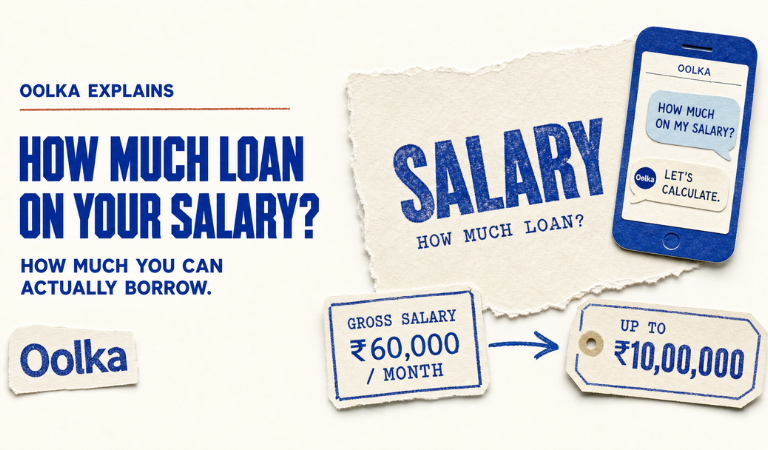
Your salary is one of the biggest factors lenders use to decide how much personal loan you can get. However, approval is also based on your existing EMIs, monthly obligations, credit history, employer profile, and repayment capacity.
Mehul, 30, from Surat, earned Rs.40,000 per month and wanted a personal loan to renovate his home. Based on online advertisements, he assumed he could easily borrow Rs.10 lakh. Instead, two lenders offered completely different loan amounts. One rejected the application because of high existing EMIs, while another approved a smaller amount after evaluating his income and repayment capacity.
This is common because there is no fixed loan amount linked to a particular salary. Every lender calculates eligibility differently.
If you understand how lenders assess salary, existing debt, and credit history, you can estimate your borrowing capacity more accurately before submitting an application.
How Do Banks Calculate Personal Loan Eligibility Based On Salary?
Personal loan eligibility is the maximum amount a lender believes you can comfortably repay based on your income and financial commitments. Salary is the starting point, but it is never the only factor considered.
Most banks and NBFCs, including Bank of Baroda, Punjab National Bank, Union Bank of India, Canara Bank, UCO Bank, LIC Housing Finance, and Muthoot Finance, evaluate:
- Monthly take-home salary.
- Existing EMIs and debt obligations.
- Employment type and job stability.
- Credit repayment history.
- Employer category.
- Loan tenure selected.
Lenders also review the Fixed Obligation to Income Ratio (FOIR), which compares your existing monthly obligations with your monthly income. A borrower earning Rs.50,000 with no existing EMIs may qualify for a higher loan than someone earning Rs.60,000 who is already paying Rs.25,000 every month towards other loans.
Some lenders also provide a personal loan eligibility calculator to estimate borrowing capacity before you apply. The final approved amount, however, always depends on the lender’s internal underwriting policy and document verification.
Personal Loan On ₹25,000 Salary
Borrowers earning Rs.25,000 per month can qualify for a personal loan, provided they meet the lender’s eligibility criteria. The sanctioned amount depends on repayment capacity rather than salary alone.
People wanting a 25000 personal loan should understand that “instant” refers to the approval process rather than guaranteed eligibility.
A borrower earning Rs.25,000 should expect lenders to evaluate:
| Assessment Factor | Effect on Eligibility |
| Monthly salary | Determines repayment capacity |
| Existing EMIs | Reduces available borrowing limit |
| Employment stability | Indicates income continuity |
| Credit history | Reflects previous repayment behaviour |
| Employer profile | Influences lending risk |
For example, a salaried employee working with the same organisation for three years and carrying no active loan obligations has stronger eligibility than someone with multiple ongoing EMIs despite earning the same monthly income.
Approval depends on the complete financial profile rather than one salary figure.
Also Read: How to Apply for an Instant 50,000 Rupees Loan? Process, Eligibility, EMI
Personal Loan On ₹30,000 Salary
A monthly income of Rs.30,000 improves borrowing capacity because lenders have greater confidence in repayment ability, provided monthly obligations remain under control.
If you want a 30000 personal loan, remember that the final amount can vary significantly between lenders. Two borrowers with identical salaries may receive different offers because of differences in existing debt, repayment history, or employer profile.
Most lenders consider:
- Monthly income after deductions.
- Existing loan repayments.
- Length of current employment.
- Type of employer.
- Overall repayment record.
For instance, a borrower earning Rs.30,000 with no existing EMIs may qualify for a substantially higher loan amount than another borrower with the same salary who is already servicing a vehicle loan and two credit cards.
Before applying, compare repayment affordability rather than focusing only on the maximum loan amount advertised by lenders.
Personal Loan On ₹40,000 Salary
Borrowers earning Rs.40,000 every month qualify for higher personal loan limits because they often have greater repayment capacity. However, income alone does not guarantee approval.
Someone wanting a 40000 personal loan should also review the strength of their credit profile before submitting multiple applications.
Lenders are more comfortable approving unsecured credit when the borrower’s repayment history is stable and existing debt remains manageable. A stronger credit profile also improves the chances of receiving a better interest rate and a longer repayment tenure.
Lenders prefer 650+ for credit cards, 700+ for personal loans, and 750+ for home loans, although every application is assessed individually.
Before approaching a lender, check credit score along with the overall report to understand whether repayment history or existing obligations could reduce your borrowing capacity. Knowing your current position beforehand can help you avoid unnecessary loan enquiries and improve your chances of approval.
Personal Loan On ₹50,000 Salary
Borrowers earning Rs.50,000 per month have access to higher personal loan limits because their repayment capacity is often stronger. Even then, lenders assess affordability before deciding the final sanction amount.
If you want a 50000 instant loan, remember that salary alone does not determine eligibility. Existing EMIs, repayment history, employer profile, age, and loan tenure all influence the final amount a lender approves.
Borrowers also look for a loan to cover planned expenses such as education, medical treatment, home repairs, or travel. Since the repayment obligation is lower than a large-ticket loan, approval may be easier if your overall financial profile is healthy.
A higher salary improves borrowing capacity, but lenders ultimately evaluate whether the monthly EMI comfortably fits within your income after considering your existing financial commitments.
Why Can Two People With The Same Salary Get Different Loan Amounts?
Two borrowers earning the same salary can receive very different loan offers because lenders evaluate overall repayment capacity rather than income alone.
Factors that influence approval include:
- Length of employment.
- Type of employer.
- Previous repayment history.
- Recent loan enquiries.
- Requested repayment tenure.
Lenders are trying to estimate whether another EMI can comfortably fit into your monthly budget. Someone earning Rs.40,000 with no outstanding obligations may qualify for a larger loan than another borrower earning Rs.50,000 who is already servicing multiple loans.
See your eligibility on Oolka before applying. Oolka prepares dispute requests where incorrect borrowing information affects eligibility, writes lender clarification emails when required, and chases correction until information is updated.
How One Incorrect Credit Entry Reduced A ₹7 Lakh Loan Offer
Priyanka, 33, from Lucknow, earned Rs.50,000 a month and applied for a personal loan to fund her postgraduate programme. Instead of the expected loan amount, the lender approved a much smaller limit after identifying an older repayment issue in her credit report.
Here’s what happened next:
- Day 1: Oolka identified that the repayment entry did not match Priyanka’s repayment records.
- Day 2: Oolka prepared the dispute request and attached the supporting payment documents.
- Day 3: Oolka drafted the lender clarification email and submitted the required information.
- Following weeks: Oolka continued following up with the lender and credit bureau until the review process was completed.
- After correction: The lender reassessed the application using the updated report during the fresh eligibility review.
The approved loan amount still depended on the lender’s credit policy, but the incorrect repayment record no longer reduced Priyanka’s borrowing capacity.
Why Should You Review Your Credit Report Before Applying?
Your credit report is one of the key documents lenders review before approving a personal loan. It contains your repayment history, active credit accounts, previous loan enquiries, and other borrowing information used during the underwriting process.
If you’ve wondered what is an Experian credit score, it is the score generated by Experian India using the credit information reported to it by lenders. Checking your report before submitting a loan application gives you an opportunity to review the information a lender is likely to assess and resolve any discrepancies through the appropriate process before the eligibility decision is made.
How Can You Improve Your Chances Of Personal Loan Approval?
Getting approved for a personal loan is not only about earning more. Lenders look for stable income, manageable debt, and a consistent repayment record before deciding how much they are willing to lend.
If your goal is to improve credit score, focus on practical steps that strengthen your overall financial profile:
- Pay all EMIs and credit card bills on time.
- Keep existing loan obligations manageable before applying for another loan.
- Avoid submitting multiple loan applications within a short period.
- Maintain stable employment wherever possible.
- Review your credit report periodically to identify incorrect information before applying.
A stronger credit profile is built over 2 to 3 years of consistent repayments rather than a few weeks. If you are planning a major expense six months from now, preparing your finances in advance results in better eligibility than applying at the last minute.
Also Read: Urgent Loans for Bad Credit: Quick & Easy Loan Solutions for Low Credit Score
The Bottom Line: Salary Opens The Door, Eligibility Decides The Loan Amount
Your monthly salary is only one part of a lender’s decision. Existing EMIs, repayment history, employer profile, loan tenure, and the information available in your credit report all influence how much personal loan you can finally receive.
Before applying, estimate your repayment capacity instead of focusing only on the maximum amount advertised. A realistic application backed by stable finances has a better chance of approval than applying for the highest possible loan amount.
Before comparing loan offers, make sure your credit profile isn’t holding you back. Oolka handles the dispute process from start to finish, including lender correspondence and follow-ups, so you apply with greater confidence.
FAQs
1. How much personal loan can I get on a Rs.30,000 salary?
The amount depends on your existing EMIs, repayment history, employer profile, and lender policy rather than salary alone. Borrowers with fewer financial obligations qualify for higher loan amounts.
2. How much personal loan can I get on a Rs.50,000 salary?
A Rs.50,000 monthly salary improves borrowing capacity, but the final approved amount varies between lenders. Existing debt and your credit profile continue to play an important role.
3. What is the minimum salary required to get a personal loan?
The minimum salary requirement differs from one lender to another. Banks and NBFCs also consider employment stability and repayment capacity while assessing eligibility.
4. How do banks calculate personal loan eligibility based on salary?
Lenders evaluate salary along with existing EMIs, employment details, repayment history, and other financial commitments. Lenders also use internal affordability models before deciding the loan amount.
5. Does my existing EMI affect my personal loan eligibility?
Yes. Existing EMIs reduce the income available for another loan and may lower the amount you qualify for. Lower monthly obligations improve borrowing capacity.
6. How can I increase my personal loan eligibility?
Reducing existing debt, paying EMIs on time, maintaining stable employment, and reviewing your credit report before applying can improve your overall eligibility. Preparing your finances before applying is often more effective than submitting multiple loan applications.