
Keeping credit utilisation low means managing your credit card balances in relation to your available limits. The most effective strategies are to repay outstanding balances, control monthly spending, make early payments when needed, and avoid maxing out your cards. These habits help you manage credit without depending on your entire available limit.
Credit utilisation affects your credit score because a high balance relative to your limit can pull your score down, even when you pay your bills on time. For example, if your credit limit is Rs.1,00,000 and your outstanding balance is Rs. 40,000, your utilisation is 40%. Reducing the balance to Rs. 20,000 brings utilisation down to 20%.
You do not need to stop using credit cards to manage utilisation. Focus on planned purchases, consistent repayments, and spending within an amount your income comfortably supports.
Keep Your Credit Utilisation Below 30%
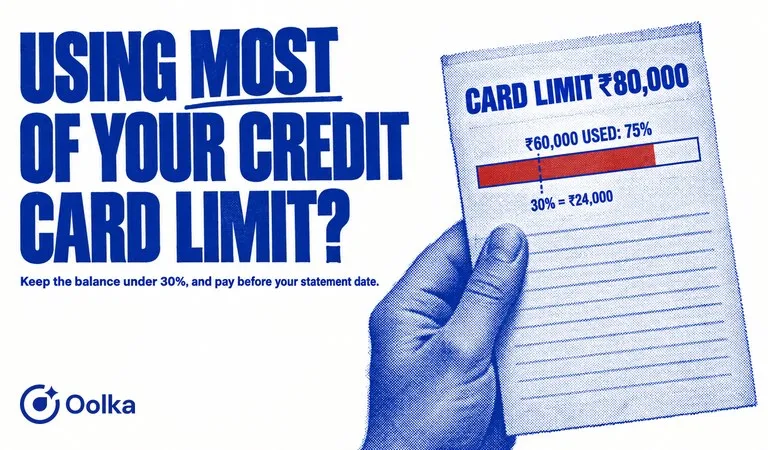
Keeping utilisation below 30% is a practical benchmark for managing credit card balances. It is not a guaranteed score threshold; a lower ratio is preferable when your budget allows. For example, with an Rs. 80,000 credit limit, 30% utilisation equals Rs. 24,000. If your balance reaches Rs. 60,000, utilisation rises to 75%. Even if you pay the bill by its due date, a high balance reported during the billing cycle could affect how your credit usage appears.
Set a personal spending target below the 30% benchmark instead of treating it as a spending allowance. If your income varies, choose a lower cap during months with higher expenses. Review your balance before making large purchases and leave room for essential spending.
The goal is to use credit when needed without depending on most of the available limit. Lower balances also leave more available credit for unexpected expenses.
Pay Down Balances Instead of Making Only Minimum Payments
Paying only the minimum due keeps your account current, but it leaves a larger portion of your outstanding balance unpaid. If you continue making new purchases while paying only the minimum, your balance could remain high, keeping your credit utilisation elevated. Paying more than the minimum helps reduce the amount you owe faster and frees up more of your available credit.
For example, if you owe Rs. 45,000 on a card with a Rs. 1,00,000 limit, your utilisation is 45%. Paying Rs. 20,000 towards that balance brings it down to Rs. 25,000, reducing utilisation to 25% once the payment is reflected.
To make extra repayments more effective, pay at least the minimum due on every card by its deadline, then put any additional amount you can afford towards reducing an outstanding balance. If you have multiple cards, prioritise the one with the highest utilisation or interest cost, depending on your repayment goal. Avoid adding unnecessary purchases while paying down the balance so that new spending does not offset your progress.
Pay Before Your Statement Is Generated
Your statement date and payment due date serve different purposes. The statement date marks the end of a billing cycle, while the due date is the deadline for paying the bill. The balance reported by a card issuer depends on its reporting schedule and processes.
If you make a large purchase early in the billing cycle, your balance could be high when the statement is generated. Paying part of it before that date helps reduce the balance, provided the payment is processed in time.
For instance, a Rs. 35,000 balance against a Rs. 1,00,000 limit equals 35% utilisation. An early payment of Rs. 10,000 brings the balance to Rs. 25,000, or 25%.
Consider an early payment when your balance approaches the limit, or you have made a large planned purchase. Check your statement closing date and allow enough time for the payment to be processed. Continue paying the amount due by the deadline; an early payment does not replace your regular bill payment. Using a credit score impact calculator alongside this habit helps you understand how changes in your outstanding balance and credit utilisation relate to your credit score.
Set a Monthly Spending Cap
To improve your credit utilisation ratio, start by setting a realistic monthly spending limit based on your total available credit, not just your income. Instead of waiting for your statement, decide how much of your available credit you intend to use during the month.
For example, if your limit is Rs. 1,20,000, a personal cap of 25% means keeping the balance at or below Rs. 30,000. This leaves room for unexpected expenses while keeping utilisation below the 30% benchmark.
Make the limit practical by setting transaction alerts, reviewing your balance weekly, and pausing non-essential purchases when you approach the cap. If you use your card for groceries, fuel, subscriptions, and online shopping, include those regular expenses in your calculation.
A spending cap works best when it reflects money you already have available to repay the bill. Do not rely on expected income or another loan to cover routine card spending. The purpose is to prevent a manageable balance from turning into revolving debt.
Use Multiple Cards Carefully
If you already hold more than one credit card, distributing planned purchases across them could prevent one card from reaching a high utilisation level. However, track both individual balances and your combined utilisation.
Suppose you have two cards with limits of Rs. 50,000 each. A Rs. 30,000 balance on one card represents 60% utilisation on that card. If the same spending is distributed as Rs. 15,000 on each card, each card has 30% utilisation. Your overall utilisation remains 30% because the combined balance is Rs. 30,000 against a total limit of Rs. 1,00,000.
This approach only helps if you avoid increasing total spending. A low ratio on one card does not cancel out the debt carried on another. Track each card’s statement date and payment deadline so that spreading purchases does not make repayments harder to manage.
Avoid applying for additional cards solely to increase your available limit. New cards bring more payment dates and opportunities to overspend. First, make effective use of the credit limits you already have.
Credit reporting practices also matter. All four credit bureaus in India, including Experian India, receive credit information from lenders, and the balances reported across your accounts help determine the utilisation reflected in your credit information. Keeping spending controlled across all cards helps you avoid high utilisation on individual cards or in total.
Request a Credit Limit Increase Only When It Makes Sense
A higher credit limit reduces utilisation if your outstanding balance stays the same. For example, a Rs. 30,000 balance against a Rs. 60,000 limit equals 50% utilisation. If the limit increases to Rs. 1,00,000, that balance represents 30%.
A higher limit does not reduce the debt itself. If you start spending more because extra credit is available, utilisation could rise again and leave you with a larger bill. The issuer also decides whether you qualify for an increase based on its own criteria.
Before requesting a higher limit:
- Assess whether your current spending is under control.
- Check whether your income supports repayment.
- Find out whether the issuer’s review involves a credit enquiry.
- Do not treat the increased limit as extra income.
- Do not use the increased limit as a reason to buy things you would otherwise postpone.
A limit increase is useful only when it gives you more available credit without encouraging more borrowing. If your current balance is already difficult to repay, focus on reducing it before seeking additional credit.
Also Read: How Does a Credit Limit Increase Affect Your Credit Score?
Choose the Right Action for Your Credit Card Situation
The best way to manage your credit utilisation ratio depends on what is driving your balance. Use this guide to choose a practical next step rather than applying every strategy at once.
| Situation | Action to take | What to watch |
| Your balance is close to the limit | Pay down the outstanding amount | Keep essential expenses covered |
| You made a large purchase | Consider an early payment before statement generation | Allow time for payment processing |
| You regularly overspend | Set a monthly card spending cap | Review transactions every week |
| One card has a high balance | Prioritise repayment towards that card | Avoid shifting debt without a plan |
| Your limit is too low for planned spending | Ask the issuer about a limit increase | Do not increase spending after approval |
To understand how much credit utilisation is good, use 30% as a practical upper benchmark and aim lower when your budget allows. Calculate utilisation by dividing your outstanding balance by your credit limit and multiplying by 100. For multiple cards, add the balances and limits before calculating the overall ratio.
A credit utilisation calculator could help estimate how utilisation changes when your balance or limit changes. However, no calculation predicts an exact score movement because other information in your credit history also affects your score.
A balance that still shows after you’ve paid raises your utilisation, so get errors corrected with the credit bureau or lender. When you check your credit score free, look for incorrect balances, duplicate accounts, or payments still shown as overdue after being paid.
Oolka helps you take action on errors by filing disputes, drafting emails to lenders, and following up until a response is received.
Key Takeaways
Keeping utilisation low comes down to reducing outstanding balances, limiting monthly card spending, paying before statement generation when necessary, and avoiding maxed-out cards. A ratio below 30% is a useful benchmark, but lower utilisation is preferable when it fits your budget. Track balances across your cards, pay bills on time, and avoid taking on new debt simply to create more available credit.
FAQs
1. What is credit utilisation, and why does it matter for your credit score?
Credit utilisation is the percentage of your available credit limit that you are using. If your card limit is Rs. 1,00,000 and your balance is Rs. 25,000, utilisation is 25%. High utilisation indicates heavier reliance on available credit and could negatively affect your score.
2. What is a good credit utilisation ratio?
Below 30% is a useful benchmark for credit card utilisation. A lower ratio is preferable when you can maintain it comfortably. This is a guideline rather than a guarantee of a specific score, as your payment history and other credit information also matter.
3. How do you calculate your credit utilisation ratio?
Divide your outstanding credit card balance by your credit limit and multiply by 100. For example, a Rs. 20,000 balance against an Rs. 80,000 limit gives you 25% utilisation.
4. Does paying off your credit card bill before the due date lower credit utilisation?
Paying down your balance reduces utilisation once the payment is processed. Paying before the statement closes could also reduce the balance reported for that billing cycle, depending on the issuer’s reporting practices. Always make at least the required payment by the due date.
5. Can a credit limit increase help reduce credit utilisation?
Yes. If your balance stays unchanged while your credit limit increases, your utilisation ratio falls. However, a higher limit does not reduce the amount you owe. Don’t increase your spending just because more credit is available.