
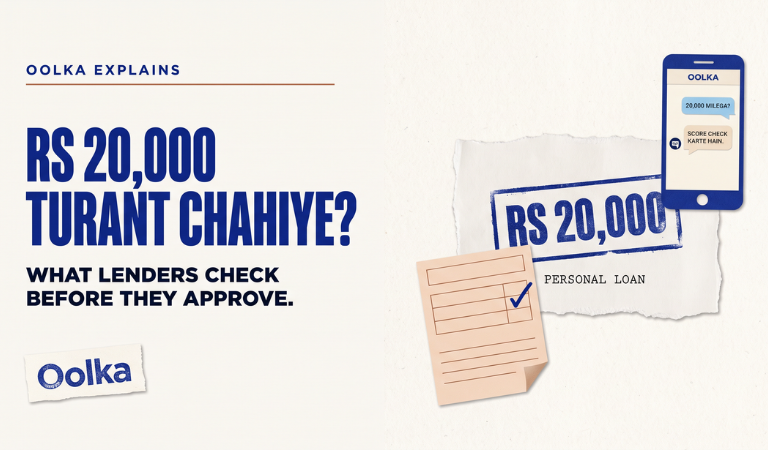
A Rs. 20,000 personal loan is suitable for short-term expenses such as medical bills, urgent travel, home repairs, or education costs. Approval depends on your income, repayment history, existing debt, and the lender’s eligibility criteria, not just your credit score.
Anup, 30, from Pune, needed Rs. 20,000 after his bike broke down on the way to work. Instead of checking whether he qualified, he applied with several lenders in a single evening. Two applications were rejected because of existing dues, while the remaining lenders asked for additional verification. Only after reviewing his credit report did he realise the issue wasn’t the loan amount. It was the information lenders were evaluating.
Before applying, understand what lenders check, how eligibility is assessed, and how your credit report affects approval. A few minutes of preparation can improve your approval chances far more than submitting multiple applications.
What Should You Know Before Applying For A ₹20,000 Loan?
A 20000 loan is an unsecured personal loan, which means lenders approve it without asking for collateral such as property, gold, or a vehicle. The decision is based on repayment capacity, existing debt obligations, income stability, and the information available in your credit report.
For a loan of Rs. 20,000, lenders still perform the same checks they would for larger personal loans. They verify identity documents, income details where applicable, repayment history, active loan accounts, and recent credit enquiries before taking a decision.
Instead of applying with multiple lenders at once, understand whether you satisfy their basic requirements first. Submitting repeated applications within a short period creates multiple credit enquiries, making lenders question whether you’re facing financial stress.
A smaller loan amount does not automatically guarantee approval. The lender still evaluates whether you can comfortably repay the EMI within the chosen tenure.
Who Can Get A ₹20,000 Instant Personal Loan?
Eligibility differs across banks, NBFCs, and digital lending platforms, but the assessment follows similar principles. Lenders evaluate whether the borrower has enough repayment capacity for the requested loan amount.
If you’re applying for a 20000 instant loan, lenders commonly review:
| Factor | Its Importance |
| Age | Applicant should meet the lender’s age criteria |
| Income | Shows repayment capacity |
| Employment | Indicates income stability |
| Existing EMIs | Helps assess monthly obligations |
| Credit history | Shows previous repayment behaviour |
| Identity and address proof | Required for KYC verification |
Salaried employees, self-employed professionals, business owners, and freelancers may all qualify if they satisfy the lender’s internal policy. Some fintech lenders also use alternate income assessment methods instead of relying only on salary slips.
Meeting the eligibility criteria improves the chances of approval, but the final decision always rests with the lender.
How Fast Can You Receive The Loan Amount?
The time taken to receive an instant loan of 20000 depends on the lender’s verification process, document completeness, and whether your application qualifies for straight-through processing. A smaller loan amount can move faster than a large personal loan, but approval is still based on eligibility and the lender’s internal checks.
The overall timeline depends on whether:
- Your KYC is complete.
- Income verification requires manual review.
- Additional documents are requested.
- The lender completes verification during business hours.
Some applications move from submission to disbursement within hours, while others take longer because further verification is required.
Applying with complete and accurate information avoids unnecessary delays. Mismatched personal details, incorrect bank account information, or inconsistencies in your credit report can slow the process even when the requested amount is only Rs. 20,000.
Also Read: How to Get Rs.10000 Loan Instantly – Process, Eligibility, EMI
Does Your Credit Score Matter For A ₹20,000 Loan?
Yes. The requested amount may be small, but lenders still review your repayment history before approving an unsecured personal loan. Lenders don’t approve or reject applications based only on one number. They also review repayment history, active loans, outstanding balances, recent enquiries, and income before taking a decision.
For unsecured borrowing, lenders also consider active loan accounts, repayment history, outstanding balances, and recent credit enquiries instead of relying only on the score.
Start with a free credit score check before submitting an application. Checking your report is free, and understanding what lenders see helps you avoid unnecessary loan enquiries. You only pay if you want Oolka to take action on issues that require disputes or lender follow-ups.
What Documents Do Lenders Ask For Before Approval?
The documents required for a Rs. 20,000 personal loan depend on the lender, employment type, and verification process. Some digital lenders complete verification electronically, while banks and NBFCs ask for additional proof before approving the application.
Most lenders ask for:
- PAN card for identity verification.
- Aadhaar card or another accepted address proof.
- Recent bank statements to review income and spending.
- Salary slips or other income proof, where applicable.
- A recent photograph if required during KYC.
Some lenders approve applications using bank statement analysis instead of salary slips, particularly for self-employed applicants, freelancers, or gig workers. The requested documents also differ between banks, NBFCs, and digital lending platforms.
Before submitting your application, complete a personal loan eligibility check. Knowing whether you satisfy the lender’s requirements reduces unnecessary applications and avoids additional credit enquiries that do not result in approval.
Can You Get A ₹20,000 Loan With A Low Credit Score?
Yes, but approval depends on more than the score itself. Lenders also review repayment history, active loan accounts, monthly obligations, and recent repayment behaviour before making a lending decision.
Someone with a lower score but stable income and no recent payment defaults may receive a different decision than someone with a higher score and repeated missed repayments.
Instead of submitting applications to multiple lenders hoping one approves the request, first understand what is affecting your report. Checking your report is free, and you only pay if you want Oolka to take action on the issues it finds.
Check your report on Oolka before applying again. Oolka handles the dispute process, prepares lender emails, and stays on top of the follow-up while you focus on getting your loan.
How One Incorrect Loan Entry Delayed A ₹20,000 Loan
Vinod, 26, from Indore, applied for a Rs. 20,000 personal loan to cover emergency travel expenses. Although he met the lender’s income requirement, the application was held back because an older loan account contained incorrect repayment information.
Instead of asking Vinod to resolve the issue himself, Oolka took over the process:
- Reviewed the disputed account and prepared the supporting documents.
- Drafted the dispute request with the relevant details.
- Prepared the lender clarification email.
- Followed up until the dispute reached resolution.
After the issue was resolved, Vinod submitted a fresh loan application using the corrected information available to the lender.
The takeaway is straightforward: before applying again after a rejection, check your report first. Finding issues is free, and you only pay if you want Oolka to take action on your behalf.
Which Credit Bureau Data Do Lenders Review?
Different lenders obtain credit information from different bureaus depending on their internal policy. Along with other verification checks, they may use data from Experian India, CRIF High Mark, or another recognised credit bureau while assessing an application.
Because reporting timelines differ across bureaus, recent repayments, loan closures, or dispute outcomes may not appear everywhere at the same time.
Before applying for a loan, it helps to review:
- Active loan accounts.
- Repayment history.
- Outstanding balances.
- Recent credit enquiries.
- Personal information linked to your credit report.
Reviewing these details before applying reduces avoidable delays and gives you an opportunity to resolve genuine issues before a lender evaluates your application.
How Can You Improve Your Chances Of Loan Approval?
Applying with complete information gives you a better chance of approval than submitting multiple applications in a short period. Lenders compare your application details with the information available in your credit report before taking a decision.
Before applying:
- Confirm that your KYC details match across all documents.
- Clear overdue EMIs or credit card payments, if any.
- Avoid submitting applications with several lenders on the same day.
- Check that closed loan accounts are reported correctly.
- Apply for an amount that matches your repayment capacity.
If you notice incorrect repayment information, duplicate loan accounts, or personal details that do not belong to you, resolve those issues before applying. It is easier to address them in advance than after a lender has already declined your application.
Is A ₹20,000 Loan Right For Your Requirement?
A 20,000 loan for 12 months spreads the repayment over a longer tenure, reducing the monthly EMI compared with shorter repayment periods. The right tenure depends on your income, monthly expenses, and how quickly you want to close the loan.
A smaller EMI makes repayment easier, but extending the tenure also increases the total interest paid over the life of the loan. Compare different repayment options before accepting the lender’s final offer.
If the expense is temporary and you expect additional income soon, a shorter tenure may reduce your overall borrowing cost. If monthly affordability is the priority, a longer tenure may suit your budget better. The right choice balances manageable EMIs with the total repayment amount rather than focusing only on monthly instalments.
Check if you’re loan ready on Oolka.
Don’t wait for another rejection to discover a report issue. Check your report on Oolka first. If action is needed, Oolka handles the dispute and follow-up.
Key Takeaways
A Rs. 20,000 personal loan is useful for managing urgent expenses, but approval depends on accurate information, repayment history, existing debt, and the lender’s eligibility checks. Applying after understanding these factors helps reduce unnecessary enquiries and improves your chances of approval.
Before submitting your application, review your credit report carefully and resolve genuine issues that could delay a lending decision. A few minutes spent checking your report is far better than dealing with repeated rejections later.
Also Read: What happens if you miss your Personal Loan EMI?
FAQs
1. How can I apply for a Rs. 20,000 instant personal loan online?
Choose a lender, complete the online application, upload the required documents, and finish the KYC process. Approval depends on the lender’s eligibility criteria and verification results.
2. Who is eligible for a Rs. 20,000 instant personal loan?
Eligibility depends on factors such as age, income, employment, repayment history, and the lender’s internal policy. Each bank or NBFC sets its own requirements.
3. Can I get a Rs. 20,000 instant loan without a high credit score?
Yes, but lenders also review repayment history, existing debt, and income before taking a decision. A lower score does not automatically result in rejection.
4. What documents are required to apply for a Rs. 20,000 personal loan online?
Most lenders ask for PAN, Aadhaar, address proof, bank statements, and income proof where applicable. Additional documents depend on the lender’s verification process.
5. How quickly can I receive a Rs. 20,000 instant personal loan?
The timeline depends on document verification, KYC completion, and the lender’s approval process. Applications with complete information are processed faster.
6. Can I get a Rs. 20,000 instant personal loan without salary slips?
Some lenders accept alternate income proof such as bank statements for self-employed applicants, freelancers, or gig workers. The final requirement depends on the lender.
7. What can a Rs. 20,000 instant personal loan be used for?
It can be used for medical expenses, travel, education, home repairs, or other personal financial needs. The lender normally does not restrict the end use.
8. How can I improve my chances of getting a Rs. 20,000 instant loan approved?
Apply with accurate information, avoid multiple loan applications at the same time, and resolve genuine issues in your credit report before submitting the application.