
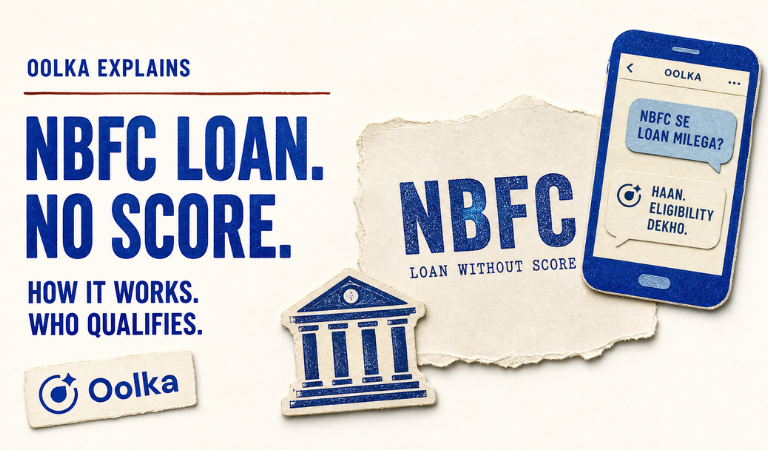
Not everyone who needs a loan has a long credit history. Many people in India — especially first-time borrowers, small business owners, freelancers, or those who have avoided credit cards — don’t have a CIBIL score at all. For years, that meant limited access to formal loans.
Non-Banking Financial Companies (NBFCs) have changed that to a large extent. Many NBFCs are willing to look beyond credit scores and focus on things like current income, banking activity, and the ability to repay. This is different from traditional banks. This approach makes it easier for people without a CIBIL score to access funds when they need them.
What Is an NBFC Loan
An NBFC loan is a loan offered by a registered non-banking financial company rather than a bank. These loans can be personal loans, business loans, vehicle loans, gold loans, or short-term working capital loans.
NBFCs follow the rules set by the Reserve Bank of India, but they have more freedom than banks. This lets them design loan products for people who might not meet the usual requirements for banks. The approval process is often faster, the paperwork is easier, and the loan amounts are based on the borrower’s current financial situation rather than just their past borrowing history.
Eligibility Criteria for NBFC Loans without a CIBIL score
If an NBFC gives you a loan without checking CIBIL, that doesn’t mean they don’t check anything at all. The evaluation just moves to other practical factors. Most NBFCs look at:
- Age: Usually between 21 and 60 years.
- Regular income: Salary, business income, freelance work, or a pension
- Active bank account: Used to check how much money is coming in and going out and to set up payments
- Stable earning pattern: Consistent deposits over the last few months
- Basic KYC: PAN, Aadhaar, and address proof
- Some NBFCs may also look at how stable your job is or how long your business has been running.
Documents Required for NBFC Loan Approval
Even if NBFCs give you a loan without checking your CIBIL score, they still need some basic paperwork to know who you are and how you handle money. It’s not so much about how you’ve handled credit in the past as it is about how stable your finances are now.
In most cases, NBFCs ask for identity and address proof, such as your PAN card and Aadhaar card. These help with basic KYC and verification. Along with that, recent bank statements are usually required — typically for the last three to six months. These statements show the lender how much money you make, how you spend it, and how well you can handle EMIs.
If you are salaried, you might also be asked for pay stubs or a letter from your employer. Self-employed people who apply might need to show proof of their business, such as invoices or GST information if they have it. The goal is not to make things more complicated, but to make sure that the loan amount and repayment plan are realistic for your situation.
Keeping these documents ready often speeds up approval and lessens the back-and-forth with the lender.
Advantages and Disadvantages of Taking an NBFC Loan without CIBIL
Loans that don’t require a CIBIL check can be helpful, but they aren’t the perfect solution. They have pros and cons, just like any other financial product.
Pros
One of the biggest advantages is access. These loans are good for individuals who are new to credit, have a thin credit file, or have had problems in the past. NBFCs often approve loans faster because they look at income patterns and bank activity instead of long credit histories.
Another benefit is speed and convenience. Applications are usually digital, documentation is minimal, and disbursement can happen within hours or a day. For urgent needs, this makes a real difference.
Drawbacks
The main problem is the cost. Interest rates on these loans can be higher than those on regular bank loans because the lender is taking on more risk by not checking CIBIL. The amount of the loan may be smaller, and the time to pay it back may be shorter.
You could also borrow money on a whim. Sometimes, having easy access to credit can make people take out loans without fully considering their repayment capacity, which can cause stress later.
Conclusion
If traditional banks turn you down, NBFC loans without a CIBIL score can be a good option. They focus more on your current financial behaviour than your past mistakes or lack of credit history. For many borrowers, this makes short-term financial support possible when it’s needed the most. That being said, it’s important to think carefully before you borrow. Always compare lenders, know the fees and interest rates, and pick an EMI that fits easily into your monthly budget. An NBFC loan without CIBIL isn’t just a quick fix; it can also be the first step in rebuilding or starting your credit journey the right way.
FAQs
Are these loans safe?
They can be safe if you choose a registered NBFC and carefully read the loan terms.
Will the interest rate be higher if you don’t have a CIBIL score?
Yes, most of the time. The interest rate may be a little higher than a regular loan because the lender is taking on more risk.
Will getting an NBFC loan help my credit score?
Yes, it can. If the NBFC tells credit bureaus about your repayment history and you pay your EMIs on time, it could help you build or improve your credit profile.
How much money can I borrow without a CIBIL score?
Loan amounts are usually smaller at first. A lot of NBFCs start with small amounts and then raise the limit once they see that the borrower is paying back the loan on time.
Who should think about getting a loan from an NBFC without CIBIL?
These loans are good for people who are borrowing money for the first time, young professionals, people who work for themselves, or anyone who hasn’t used formal credit before but has a steady income.