
Loan closed. Thought it was done. But the next loan application rejected.
Neeraj, 35, from Delhi, applied for a Rs. 4 lakh personal loan. Salary was Rs. 52,000. There were no active EMIs. Still rejected. Reason: “Settled account.”
He had stopped paying an old credit card years ago, then later settled it for a lower amount. He assumed it was resolved. It wasn’t.
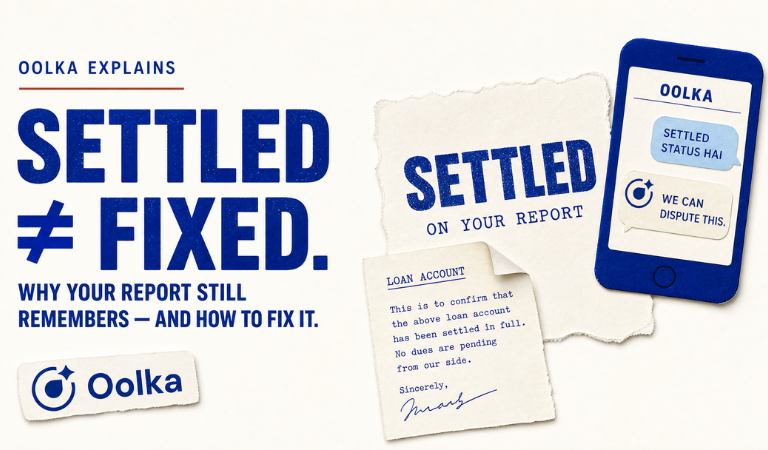
Here’s something to remember: Written-off or settled means the loan wasn’t repaid as agreed. It stays in your report and affects approvals.
This is why understanding what is CIBIL score alone is not enough. Lenders don’t just look at the number. They look at how you have handled credit in the past.
What Do Written-Off and Settled Status Mean in CIBIL?
A written-off account in CIBIL means the lender has marked the loan as a loss after prolonged non-payment, usually after the account becomes a non-performing asset.
This is the written-off meaning in CIBIL from a credit reporting perspective.
Be aware of the correct write off meaning in CIBIL to avoid any issues. The lender writes it off for accounting purposes, but recovery efforts may continue depending on the lender.
A settled account is different.
It means the borrower repaid only a portion of the outstanding amount, and the lender agreed to close the account with that reduced payment.
So in simple terms:
Written-off means no repayment for a long period
Settled means partial repayment accepted by the lender
Both indicate that the original loan terms were not fulfilled.
Written-Off vs Settled: What’s the Difference
| Status | Meaning | Repayment | Impact on Approval |
| Written-off | Loan marked as a loss after prolonged non-payment | No repayment or very delayed | High risk, approvals are difficult |
| Settled | Loan closed after partial payment agreed by the lender | Partial repayment | Negative impact, but better than written-off |
This is how lenders read it.
Both indicate that the original loan terms were not followed, but the level of risk is assessed differently.
What This Means for Your Credit Profile
Lenders evaluate behaviour, not just current numbers.
The written off loan meaning from a lender’s perspective is risk. It shows that repayment stopped for an extended period.
If your report shows written off in CIBIL or settled entries, it can lead to:
Lower approval chances
Stricter checks
Higher interest rates
Lower sanctioned amounts
This is where understanding the loan write off meaning matters. It impacts your credit score. The entries will continue to have an effect on loan approvals in the future.
Also Read: How To Improve Credit Score Using AI?
Does Paying Later Remove Written-Off or Settled Status?
Many borrowers assume that repayment will make everything perfect. It will not.
In cases where the loan was written off and later repaid, the status might be updated. However, the history of the default stays.
If it was settled, it continues to reflect that full repayment was not made.
Lenders can see this clearly in the report.
This happens to be one of the most common misunderstandings held by borrowers. They tend to believe that paying back immediately clears the impact of the default. In reality, lenders still review the repayment history attached to the account.
A written-off or settled entry tells them that repayment problems existed at some point, even if the dues were later cleared. Information about recent repayments is helpful, but older negative entries are also considered in lending decision-making.
How Long Do Written-Off or Settled Entries Stay on a CIBIL report?
Written-off and settled accounts do not disappear quickly.
They can remain in your credit report for up to seven years from the date of default.
Even after repayment, the record stays with updated remarks.
Over time, consistent repayment behaviour helps reduce the impact, but it does not erase the history immediately.
That explains why some borrowers find themselves puzzled despite clearing their debts, and yet still denied credit access. The purpose of credit reports is to reflect past behavior instead of just the present situation.
Lenders use this information to understand repayment consistency over time. The impact becomes less significant with time if new accounts are kept clean and timely repayments are made.
How Can You Fix Written-Off or Settled Status in CIBIL?
The approach depends on accuracy.
If correct:
Repay the full outstanding amount wherever possible
Request the lender to update the account as “closed”
If incorrect:
Check your repayment records and supporting proof
Raise a correction request with the lender or bureau
Track the update until the status is corrected
This is where people search for how to remove written off from CIBIL or how to remove written off on credit report.
The process of fixing involves:
Checking your full report
Identifying incorrect entries
Matching with repayment proof
Raising a correction request
Tracking updates
Fixing incorrect reporting is critical before applying again.
Most borrowers only discover these entries after a rejection.
Oolka scans the full credit report and flags written-off or settled accounts affecting approvals. It also identifies cases where the reported status does not align with the repayment history reflected in the report. Check your report on Oolka today.
What Happens When Written-Off or Settled Status Is Checked on Oolka
If a loan is marked written-off or settled, the issue is not just the label. It is whether that status is correct and how it is affecting your profile.
Below is the step-by-step process Oolka follows so that you don’t have to:
Step 1: Scans your full credit report and identifies written-off and settled accounts
Step 2: Checks whether the status aligns with your repayment history
Step 3: Flags accounts where the status appears incorrect or outdated
Step 4: Prepares the correction process required for each case
Step 5: Tracks the account until the updated status reflects in your report
This is not something most people track manually.
Many borrowers don’t realise that a written-off or settled entry is the reason behind rejection. This brings that into focus early.
Real Story: Small Decision, Long Impact
Kishan, 33, Mysore.
Starting point: Credit score 728. Loan rejected.
Reason: One credit card account was still marked as “settled” even after the dues had already been cleared.
He assumed the lender had updated the account correctly. It hadn’t reflected in the report.
What happened next:
Day 1, the report was reviewed and the incorrect settled entry was identified.
Week 1, repayment records and closure details were matched against the report.
Week 2, the correction request was prepared and raised.
Month 1, the account status was updated in the report.
Result: Loan approved at better terms.
Lesson: Incorrect written-off or settled entries can continue affecting approvals until the report is corrected properly.
Should You Clear the Full Amount or Choose Settlement?
Settlement reduces the immediate financial burden, but it impacts your credit profile.
A settled account reflects that the borrower did not repay the full amount.
On the other hand, clearing the full dues and closing the account properly is always better for your credit history.
If future loan approval matters, full repayment is the stronger option.
Although a settlement can give you some respite financially, lenders tend to consider it an incomplete payment. This becomes important during home loans, business loans, or high-value credit applications where repayment history is examined more closely.
It would be better to pay off all the debts and close out the account properly to create a stronger credit profile in the long run.
Also Read: How Long Does It Take to Reach an 800 Credit Score in India?
Common Mistakes to Avoid
- Ignoring old loan accounts
- Assuming repayment removes past records
- Choosing settlement without understanding impact
- Not reviewing credit reports regularly
- Applying for loans without fixing existing issues
These errors will hinder the process of recovering your credit profile.
These mistakes usually remain unnoticed until a loan application gets delayed or rejected. Many borrowers only review their report after a lender raises concerns. Regularly checking your report and resolving incorrect entries early helps prevent larger approval issues later.
The Bottom Line: Impact of Written-Off or Settled Status in CIBIL
Written-off and settled statuses are not just labels. In reality, they show how the loan was managed once it became difficult to repay it.
What you need to know:
Written-off reflects prolonged non-payment
Settled reflects partial repayment
Both affect loan approvals
Repayment alone does not erase history
Correcting status improves your profile
In the event that your loan application gets denied even with a reasonable score, this could be why.
Oolka flags written-off and settled accounts impacting approval chances. Raises dispute when the status is not right or not up to date and follows through to ensure that the change in status shows up in your report.
FAQs
1. What does ‘Written Off’ mean in a CIBIL report?
Written off in a CIBIL report means the lender has marked the loan as a loss because of the nonpayment over a long period, although the recovery process can continue despite this.
2. What happens when a loan is marked as written off?
It is written off by the lender for accounting reasons, but it will remain on your credit report and could affect future loans.
3. How does ‘Written Off’ status affect my credit score and loan approval chances?
It decreases your score and indicates high risk to lenders, thus reducing the chances of getting approval, as well as resulting in stricter loan conditions.
4. How long does a written-off account remain on my CIBIL report?
It can remain for up to seven years from the date of default, depending on how it is reported.
5. Can a written-off status be removed from my CIBIL report?
It cannot be removed if accurate, but it can be updated after repayment or corrected if reported incorrectly.
6. How can I remove a write-off entry from my CIBIL report?
The dues can be paid in full for updating the status, or else raise a correction request with supporting proof if the entry is inaccurate.
7. How do I resolve a written-off loan account?
You can resolve it by clearing all outstanding amounts owed and making sure that the lender changes the status of the account accordingly.
8. How can I clear or settle a written-off loan?
You can repay the full amount or negotiate a settlement, but full repayment is better for your credit profile.
9. What does ‘Debt Settlement’ mean?
It refers to paying off the loan with an amount less than the total that the lender agrees to accept as final settlement.
10. How can I remove settled status from my CIBIL report?
Even though you cannot remove it when it’s correct, you can correct any mistakes and build a good credit profile.
11. Which is better for credit score: Written Off or Settled?
Lenders treat both as serious negative entries because they indicate repayment issues. The exact impact and interpretation can vary depending on the lender.
12. Will a settled account stay on my report after I pay the remaining amount?
Yes. Even if you later clear the remaining dues, the earlier settlement history may still remain visible in the report.