
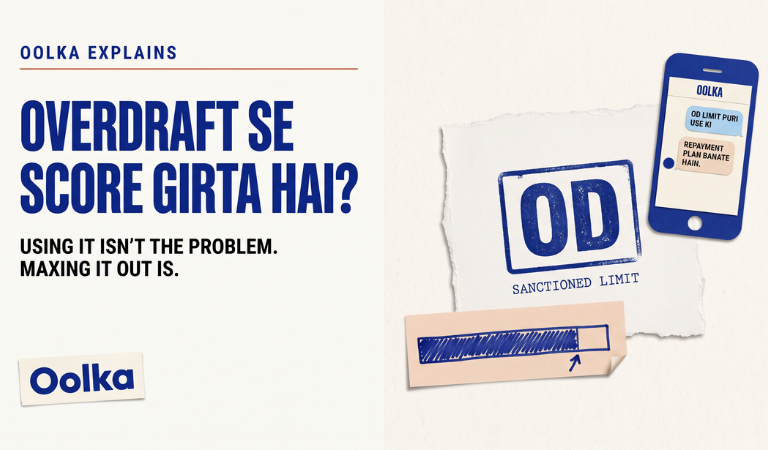
Yes. Using an overdraft can affect your credit score when the facility is reported to a credit bureau, especially if you repeatedly use a high portion of the sanctioned limit, miss repayments, or exceed the approved limit.
Vineet, 34, from Bengaluru, had a Rs. 2 lakh overdraft facility linked to his bank account. He used Rs. 1.6 lakh for three months while waiting for a business payment. His account remained within the approved limit, so he assumed there was no credit impact. When he later applied for a personal loan, the lender reviewed his outstanding overdraft and repayment history before making a decision.
An overdraft is not free money. It is a credit facility, and how you use it can become part of the information shared with credit bureaus such as Experian India, CRIF High Mark, and Equifax.
How Does An Overdraft Work In India?
An overdraft lets you withdraw more money than the balance available in your bank account, up to a sanctioned limit. The bank charges interest on the amount actually used, not the entire approved limit.
For example, if SBI approves a Rs. 1 lakh overdraft and you use Rs. 30,000, interest is charged on the Rs. 30,000 outstanding according to the facility terms. Repaying that amount restores the available limit.
Overdraft facilities in India come in different forms. A salary account, savings account, fixed deposit, or business banking relationship can sometimes be linked to an overdraft facility, depending on the lender’s eligibility rules.
The important point is that an overdraft is a form of credit. The bank decides the limit, charges interest on usage, and sets repayment conditions. If the facility is reported to credit bureaus, the outstanding amount and repayment behaviour become part of the data lenders review when assessing new credit applications.
Does Overdraft Affect Credit Score?
Whether an overdraft affects your score depends on how the lender reports the facility and how you use it. Simply having an overdraft limit does not automatically mean your score will fall.
The biggest factors are repayment behaviour, outstanding usage, overdue amounts, and whether you exceed the approved limit.
| Overdraft Activity | Likely Credit Impact |
| Facility approved but not used | Limited direct impact |
| Small amount used and repaid on time | Lower risk |
| High portion of limit used repeatedly | Can affect lender assessment |
| Payment remains overdue | Negative repayment signal |
| Limit exceeded | Can trigger charges and recovery action |
| Account remains unpaid for a prolonged period | Serious credit concern |
A Rs. 2 lakh limit with Rs. 20,000 used is different from the same facility carrying Rs. 1.9 lakh for several months. Lenders looking at credit information can see the reported outstanding and repayment behaviour when the facility is furnished to them.
If a closed overdraft is still showing as active or the outstanding amount is incorrect, do not leave it there. Find the issue on Oolka for free, then let Oolka file and follow up on the dispute.
Also Read: How Credit Card Usage Affects Your Credit Score?
Does Overdraft Utilisation Matter For Your Credit Score?
Yes. High utilisation means a large portion of the sanctioned overdraft is being used. If the facility is reported as a revolving or credit account, sustained high usage can become a negative factor in lending decisions.
This is why overdraft and credit score are connected. The score itself is not determined by one number such as overdraft usage alone. Credit bureaus consider several aspects of reported credit behaviour, including repayment history, outstanding debt, credit age, account mix, and recent credit applications.
Consider two borrowers:
Borrower A: Rs. 2 lakh limit, Rs. 25,000 used, repayments made on time.
Borrower B: Rs. 2 lakh limit, Rs. 1.8 lakh used continuously, with delayed repayments.
Both have the same sanctioned limit. Their reported credit behaviour is very different.
If your overdraft remains heavily utilised, reducing the outstanding balance and making repayments on time is more useful than simply keeping the facility open.
Does Applying For Overdraft Affect Credit Score?
Applying for an overdraft does not automatically reduce your score. The impact depends on whether the bank performs a credit enquiry as part of the application and how that enquiry is recorded by the relevant credit bureau.
When you apply for an overdraft with HDFC Bank, Axis Bank, ICICI Bank, SBI, or another lender, the institution evaluates factors such as income, existing debt, banking relationship, collateral where applicable, and credit history.
A credit enquiry is different from an approved overdraft account. A lender can make an enquiry while assessing your application even if the facility is not ultimately approved.
If you submit applications to several lenders within a short period, those enquiries can become part of your reported credit history. That is why applying selectively is better than submitting multiple overdraft applications simply to compare limits.
What Happens If You Exceed Your Overdraft Limit?
Exceeding an approved overdraft limit means you have withdrawn more than the bank has agreed to lend under the facility. The bank can reject further transactions, apply charges according to the agreement, demand repayment, or take recovery action if the excess remains unpaid.
For example, if your approved limit is Rs. 1 lakh and your outstanding reaches Rs. 1.08 lakh, the additional Rs. 8,000 is not part of your sanctioned borrowing. The bank can require that excess to be cleared immediately.
Do not treat an overdraft limit as a flexible target. If you know that you cannot clear the outstanding amount, contact the bank before the facility becomes overdue.
A prolonged unpaid excess can create a much bigger problem than a temporary shortage of funds. It also gives the lender a stronger reason to reassess the facility and your future credit applications.
There is a common question among many individuals: Does overdrafting affect credit score? The answer is: exceeding the approved limit is more concerning than simply using a permitted portion of the facility.
How One Overdraft Error Delayed A ₹7 Lakh Loan
Sneha, 38, from Pune, had closed a Rs. 1 lakh overdraft facility linked to her savings account. Months later, she applied for a Rs. 7 lakh personal loan. The credit report showed the overdraft as active with an outstanding amount that Sneha had never owed.
The problem was not high usage. It was incorrect reporting.
Oolka took action instead of asking Sneha to chase the bank herself:
- Oolka filed a dispute against the incorrect overdraft status.
- It drafted the objection email to the bank.
- It followed through on the correction request with the lender.
- It continued the dispute process until the reported information was corrected.
The lesson is simple: an overdraft affects lending decisions differently when the reported data itself is wrong. In that situation, the answer is not to wait for the next report. The incorrect entry needs to be challenged.
How Should You Manage An Overdraft Without Hurting Your Score?
Keep the outstanding amount under control and repay what you use according to the facility terms. An overdraft works best as a short-term liquidity facility, not as a permanent replacement for income.
If you have a Rs. 2 lakh limit, using Rs. 1.8 lakh continuously creates a different lending picture from using Rs. 20,000 and clearing it promptly. Keep enough money available to meet repayment requirements and avoid exceeding the sanctioned limit.
Before applying for another loan, check credit score free and review the accounts being reported under your name. Look for incorrect overdraft balances, overdue amounts, closed accounts still showing as active, or facilities you do not recognise.
If the information is wrong, raise the issue with the relevant lender and credit bureau rather than ignoring it.
Check your report on Oolka before you take that step. Oolka raises disputes for incorrect entries, drafts lender emails, and follows up with the lender until you receive a response.
Also Read: 5 Tips for Improving Your Credit Score Quickly and Effectively
The Bottom Line: Overdraft And Credit Scores
An overdraft does not automatically damage your credit score. The risk comes from how much you use, whether repayments are made on time, whether you exceed the sanctioned limit, and what the lender reports to credit bureaus.
If you keep the outstanding amount under control, repay according to the facility terms, and address incorrect reporting promptly, an overdraft does not have to become a barrier to future credit.
FAQs
1. Does using an overdraft facility affect my credit score?
It can affect your score when the facility is reported, and the account shows high usage, overdue payments, or other negative repayment behaviour. Simply having an approved limit does not automatically lower your score.
2. Is an overdraft account reported to credit bureaus?
A lender can report an overdraft facility to credit bureaus. The reporting depends on the facility and the lender’s reporting practices.
3. Does overdrawing my account always hurt my credit score?
No. Using an overdraft within the sanctioned limit and repaying it according to the terms does not automatically hurt your score. The problem arises when usage remains high, repayments are missed, or the account becomes overdue.
4. What happens if I exceed my overdraft limit?
The bank can reject further withdrawals, charge applicable fees, and demand immediate repayment of the excess amount. Continued non-payment can lead to recovery action and negative credit reporting.
5. Does high overdraft utilisation lower my credit score?
High utilisation can become a negative factor when the overdraft is reported as a credit facility. Sustained high outstanding balances can also make lenders more cautious about approving additional credit.
6. What credit score is required to get an overdraft facility?
There is no single score required across all banks and overdraft products. Lenders also consider income, banking relationship, existing obligations, repayment history, and security such as a fixed deposit where applicable.