
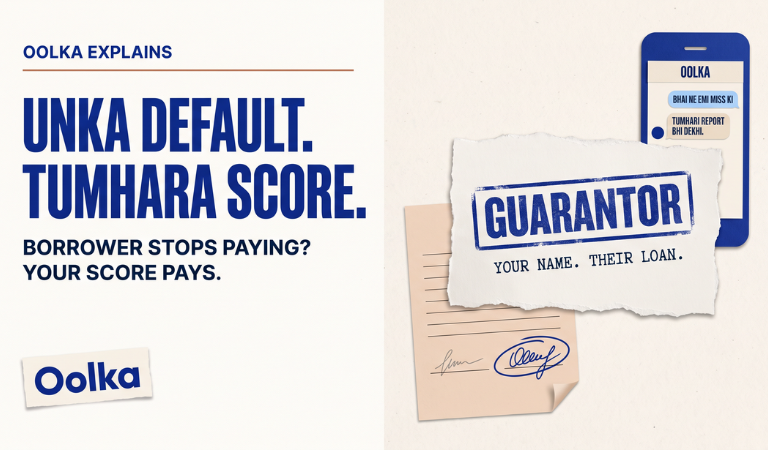
A borrower’s default on a guaranteed loan can affect the guarantor’s credit score because the guarantor shares responsibility for the debt if the borrower fails to repay.
Naveen, 38, from Pune, agreed to guarantee his cousin’s Rs. 8 lakh personal loan. The borrower stopped paying after losing his job. Naveen had never received the loan money, so he assumed his own credit history would remain untouched. When he later applied for a home loan, the guaranteed account and its repayment problems became part of the lender’s assessment.
Signing a guarantee is not the same as being a reference. It creates a legal obligation connected to the loan. If the borrower defaults, the guarantor can face repayment demands and adverse credit reporting.
That is why becoming a guarantor needs the same caution as taking on debt yourself.
What Does Being A Guarantor Mean?
A guarantor agrees to repay a loan if the primary borrower fails to meet the repayment obligation. The guarantee creates a legal responsibility, so the lender can approach the guarantor when the borrower defaults.
This means becoming a guarantor for loan repayment involves more than simply vouching for another person’s application. The guarantee connects that person to the repayment obligation. Banks such as SBI, HDFC Bank, Axis Bank and ICICI Bank use guarantee agreements as part of their lending arrangements, while NBFCs such as Bajaj Finserv, Tata Capital and IIFL follow their respective loan documentation.
The guarantee itself does not automatically reduce your score. The risk starts when the borrower misses payments, and adverse repayment information is reported against the guaranteed account.
How Does A Borrower’s Default Affect The Guarantor?
A borrower’s default affects the guarantor when overdue repayment information on the guaranteed account is reported against the guarantor’s credit record. The lender does not need to wait for the borrower to finish every recovery stage before the guarantor’s liability becomes relevant.
The important distinction is between personal loan guarantor status and default. Signing the guarantee does not itself damage your score.
Suppose a borrower stops paying a Rs. 20,000 monthly EMI. The lender records the overdue amount on the loan account. Where the guarantor is linked to that account in credit reporting, those missed payments can affect the guarantor’s credit history too.
This creates a risk even though the guarantor never received the loan proceeds. A clean repayment record on your own loans does not cancel adverse information connected to a guaranteed loan.
If you are planning to apply for a Rs. 25 lakh home loan or Rs. 7 lakh personal loan, the lender could consider that repayment history while assessing the application.
Something wrong with a guaranteed loan on your report? Oolka can handle the issue seamlessly, from filing the dispute to sending the lender an objection letter.
Does Being A Guarantor Affect Your Credit Rating?
Yes, acting as a guarantor exposes your credit rating to the borrower’s repayment behaviour. The guarantee itself is not a negative entry, but missed payments on the guaranteed account can become adverse information associated with your credit report.
If the borrower pays every EMI on time, becoming a guarantor does not automatically reduce your score. The problem starts when repayments become overdue, and the lender reports those delays.
For example, suppose you guarantee a Rs. 5 lakh loan. The borrower misses two Rs. 14,000 EMIs. If those missed payments are reported against the guaranteed account, another lender reviewing your report could see the repayment problem even though you did not receive the Rs. 5 lakh.
That matters when applying for fresh credit. A lender assessing a home loan, personal loan or credit card looks at repayment history alongside income, existing debt and recent applications.
The practical point is simple: guaranteeing someone else’s loan gives you exposure to their repayment behaviour.
How Much Can Your Credit Score Drop?
There is no fixed number of points that every guarantor loses after a borrower defaults. Credit bureaus do not publish a universal rule saying that a guaranteed-loan default causes a specific 20-point, 50-point or 100-point reduction.
The impact depends on the existing repayment history, severity and duration of the overdue payment, outstanding debt, recent enquiries and other information in the report.
| Guaranteed-loan situation | Possible effect on guarantor | Immediate step |
| Borrower pays on time | No negative repayment event | Keep checking statements |
| One payment becomes overdue | Adverse repayment information can arise | Confirm payment status |
| Multiple EMIs remain unpaid | Credit damage becomes more serious | Contact lender and document communication |
| Account is in prolonged default | Recovery and repayment liability increase | Address the debt and challenge incorrect reporting |
A guarantor with a 780 score should not assume a default will automatically take the score below 700. Equally, someone at 640 should not assume the effect will be insignificant.
The exact score movement has to be checked after the lender reports the account.
What Should You Check Before Becoming A Guarantor?
Before agreeing to become a guarantor, treat the loan as a liability that could become yours. Read the guarantee agreement instead of relying only on what the borrower says about the loan.
Check:
- Total sanctioned and outstanding amount
- Monthly EMI and repayment schedule
- Loan tenure and interest terms
- Whether the guarantee covers the entire debt
- What happens after borrower default
- Whether the lender can demand payment from you
- How your liability ends
Someone acting as a guarantor for personal loan should also ask why the borrower needs a guarantor. Weak repayment capacity, unstable income or heavy existing debt increases the risk of missed EMIs.
Do not agree only because the borrower is a relative or close friend. A Rs. 10 lakh guarantee could become your repayment responsibility if the borrower stops paying.
Understanding the liability before signing is far easier than dealing with its consequences later.
How One Guaranteed Loan Became A Problem For A Home Loan
Meera, 35, from Delhi, had guaranteed a Rs. 9 lakh personal loan for a family member. The borrower eventually repaid the outstanding amount and the account was closed. Months later, while Meera was preparing to apply for a Rs. 22 lakh home loan, she noticed that the guaranteed account was still showing an overdue amount on her credit report.
The problem was not the original default. The issue was that the account information had not been updated correctly after the outstanding amount was paid.
Oolka took action instead of treating the entry as something that could simply be deleted:
- It reviewed the guaranteed account and identified the mismatch between the reported overdue amount and the available repayment records.
- It prepared the dispute.
- It drafted the lender objection email explaining the incorrect outstanding status.
- It followed up with the lender on the correction request until the reporting issue was addressed.
Meera’s case was about correcting inaccurate information, not removing a genuine default. That distinction matters: accurate negative repayment history cannot be erased because someone was a guarantor, but incorrect information about the account’s status, balance or repayment record can be challenged with evidence.
The lesson is straightforward: after a guaranteed loan is repaid, check how the account is being reported. If the credit report still shows an overdue amount that no longer exists, the issue is the accuracy of the reporting and needs to be disputed.
Can A Guarantor Be Asked To Repay The Loan?
Yes. A guarantor accepts contractual liability under the guarantee agreement if the borrower defaults. The lender’s rights depend on the guarantee terms and applicable law.
If a borrower stops paying a Rs. 12 lakh loan, the lender can pursue recovery from the borrower and enforce the guarantor’s obligations according to the guarantee agreement. Being the guarantor does not make you the original borrower, but it does create a repayment obligation when the conditions in the agreement are triggered.
RBI’s Master Direction – Reserve Bank of India (Credit Information Reporting) Directions, 2025 sets the regulatory framework for credit information reporting by regulated entities and credit information companies.
If you receive a repayment demand, read the guarantee agreement carefully and seek legal advice before ignoring it.
How Can You Fix Credit Score Problems After A Guaranteed Loan Default?
You cannot erase accurate default information simply because you were the guarantor. If the information is correct, the route is to resolve the overdue debt and then maintain timely repayments.
If the information is wrong, challenge it with evidence. Examples include an account incorrectly linked to you, an incorrect overdue amount, duplicate reporting or repayment information that does not match the lender’s records.
Keep payment receipts, lender statements, guarantee documents and correspondence connected to the account. If your complaint isn’t resolved within 30 days of filing it, you’re entitled to Rs. 100 for every day of delay.
One question many individuals have is: how to fix credit score? It is best to start with the account causing the problem instead of taking new credit to offset the damage. Correcting inaccurate information and maintaining timely repayments are the actions that address the underlying issue.
What Happens To The Guarantor’s Credit Report After Default?
The guaranteed account remains relevant to the guarantor while the repayment obligation and reported information continue. Paying the overdue amount does not necessarily erase accurate historical repayment information immediately.
The key distinction is between loan guarantor liability and incorrect reporting. If the borrower genuinely defaulted, the guarantor cannot simply demand deletion of accurate information because they did not receive the money. If the lender reported the wrong amount, wrong status or wrong account association, that information can be challenged.
A guarantor should therefore keep copies of the guarantee agreement, payment records, lender correspondence and dispute acknowledgements. These documents become important if the lender or bureau needs evidence to correct an entry.
The aim is not to remove accurate history. It is to ensure the report records the correct facts.
Check your report on Oolka. Find the problem first, then let Oolka handle the dispute and lender follow-up for you.
Key Takeaways
A guaranteed loan creates real credit and repayment exposure for the guarantor. A borrower’s default can affect the guarantor’s credit score, while prolonged non-payment can also trigger demands under the guarantee agreement.
Before signing, understand the amount, EMI, tenure and liability. If a default is already affecting your report, separate accurate information from errors and take action against incorrect entries rather than waiting for them to disappear.
FAQs
1. Does a borrower’s default affect the guarantor’s credit score?
Yes, a reported default on a guaranteed loan can affect the guarantor’s credit score because the guarantor is linked to the repayment obligation. The impact depends on the reported account information and severity of the default.
2. Does becoming a guarantor always lower your credit score?
No, becoming a guarantor does not automatically lower your score. The risk arises when the borrower misses payments, or the guaranteed account develops adverse repayment information.
3. How many points can a credit score drop if the borrower defaults?
There is no fixed number of points that applies to every guarantor. The movement depends on the existing repayment history, overdue severity, duration and other reported credit information.
4. How long does a defaulted guaranteed loan stay on the guarantor’s credit report?
Accurate negative repayment information remains according to applicable credit bureau retention and reporting rules. Paying or resolving the account does not necessarily remove historical information immediately.
5. Is the guarantor legally responsible for repaying the loan if the borrower defaults?
A guarantor accepts contractual liability under the guarantee agreement when the borrower defaults. The lender’s ability to demand repayment depends on the agreement and applicable Indian law.
6. Can the guarantor’s assets be seized if the borrower defaults?
A lender cannot simply seize assets because someone signed a guarantee without following the applicable legal and recovery process. Enforcement depends on the guarantee terms, outstanding debt and the legal process available to the lender.