
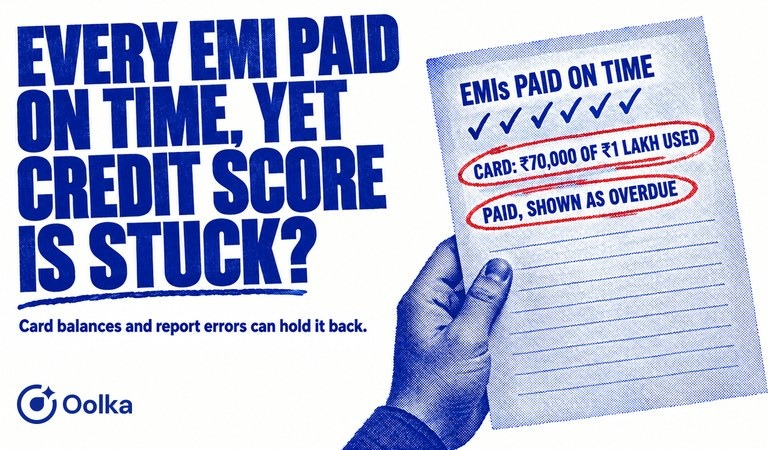
Your credit score stops rising when repayment patterns, outstanding debt, credit applications, or errors in your credit report continue to work against you. Paying every EMI on time matters, but it doesn’t guarantee an immediate increase.
A borrower who paid off a personal loan and continued paying every EMI on time noticed that their score had barely changed over several months. On checking their credit report, they found that a high credit card balance and an overdue amount reported incorrectly were still affecting their credit history.
If your score still isn’t moving, check for outdated overdue amounts, closed loans still marked active, or hard inquiries from recent applications. Each issue requires a different response, so extra payments without identifying the cause could waste time and money. Find what is holding your score back, correct reporting errors, and address the borrowing or repayment habits responsible. Here are seven possible reasons for a stalled score and how to address them.
1. Are High Credit Card Balances Holding Your Score Back?
A high credit card balance is one reason a credit score increase stalls, even when every bill is paid on time. Credit utilisation measures how much of your available revolving credit you use. If your total limit is ₹1 lakh and your reported balance is ₹70,000, your utilisation stands at 70%. That signals heavy dependence on available credit.
Paying the minimum due avoids some immediate consequences, but it leaves the remaining balance outstanding, and interest continues to accumulate. A high balance reported at the end of a billing cycle also affects the information lenders see, even if you repay it later.
Take these steps:
- Reduce the outstanding balance: Pay more than the minimum due and prioritize high-interest debt.
- Control new spending: Avoid adding purchases while trying to bring utilisation down.
- Check the reported balance: Review your credit report after the card issuer updates your account.
There is no universal utilisation percentage that guarantees a score increase. The goal is to keep balances low relative to available limits and maintain that pattern over time.
2. Are Late Payments Still Affecting Your Score?
A missed EMI or credit card payment can affect your credit history even after you clear the overdue amount. If your score isn’t improving even after you’ve cut your debt, review each account for missed payments, overdue balances, or inaccurate payment statuses. Pay genuine dues and dispute incorrect entries with the relevant lender.
Prevent another missed payment with a system that works even when you are busy:
- Set automatic payments for at least the minimum due, while keeping sufficient funds in the linked account.
- Schedule EMI reminders several days before each due date.
- Review bank statements and payment confirmations to catch failed transactions.
- Contact the lender promptly if a payment was debited but reported incorrectly.
A cleared overdue amount does not erase accurate historical information immediately. Consistent on-time repayments rebuild positive recent history, but the score responds to reported data rather than the effort you make behind the scenes.
3. Has Loan Settlement Left a Negative Mark?
Loan settlement differs from repaying the full amount owed. When a lender accepts less than the contractual dues, the account could be reported as settled rather than closed after full repayment. This distinction matters when future lenders assess your repayment history.
A loan settlement entry does not disappear after you pay the agreed settlement amount. Check the account status and outstanding balance. If the entry is accurate, do not dispute it as an error. Contact the lender to clarify any remaining dues and available options. If the reporting is incorrect, use your settlement letter, payment receipts, and lender correspondence to challenge it.
Settling won’t raise your score. If you can repay the full amount, the loan shows as closed rather than settled. Never commit to payments you cannot sustain in pursuit of a quick score increase.
4. Are You Applying for Too Much Credit at Once?
Repeated applications for personal loans, credit cards, or other borrowing can create several hard inquiries within a short period. Each inquiry records that a lender requested your credit information after an application. A cluster of applications can suggest urgent demand for credit, and the inquiries can affect your score.
If you’ve applied a few times recently and your score still isn’t going up, pause before applying again. Repeated applications to see who approves you add hard inquiries without addressing the underlying issue.
Instead, use a more deliberate process:
- Check eligibility criteria before submitting a formal application.
- Compare suitable products and shortlist options before applying.
- Avoid applying for several products at once without a clear need.
- Review the inquiry section of your report and dispute any inquiry you do not recognize.
Checking your own report is different from a lender’s hard inquiry and does not, by itself, lower your score. You do not need to stop using credit altogether. Focus on applying when you have a genuine requirement and a reasonable chance of meeting the eligibility conditions.
An error in your report can keep holding your score back until it’s corrected. Check your credit report for free and let Oolka handle disputes and lender communication when an error needs attention.
5. Is Your Credit History Too Short or Limited?
A limited borrowing history gives lenders less evidence of how you manage credit over time. If you recently opened your first credit card or took your first loan, your repayment record is shorter than that of someone with established accounts.
Avoid borrowing unnecessarily just to build a score, as extra loans add interest costs and repayment obligations. Instead, use existing credit responsibly, pay your full credit card statement balance by the due date, and keep older accounts in good standing when their fees and terms make sense.
There is no fixed deadline for a score to rise. Consistent account management and time help build a clearer record of your borrowing and repayment behavior. Opening several credit products in quick succession is not a substitute for that history.
6. Are Errors or Outdated Entries Dragging Your Score Down?
Your credit report might contain a duplicate account, a payment marked overdue despite being paid, an incorrect outstanding balance, or a loan that does not belong to you. Such errors need correction; making additional payments will not fix inaccurate reporting. A credit score check should include the detailed report, not just the three-digit number.
Credit bureaus such as CRIF High Mark, Equifax, and Experian India maintain credit information supplied by lenders. Check the account details and payment history carefully, then compare questionable entries with your statements and loan documents.
Use this table to match the issue with the next step:
| Report issue | Evidence to gather | First action |
| Payment incorrectly shown as overdue | Bank statement or payment receipt | Dispute the payment status |
| Closed loan shown as active | Closure letter or no-dues certificate | Request correction from the lender |
| Duplicate account | Account statements and loan documents | Challenge the duplicate entry |
| Account you do not recognize | Report details and identity records | Raise a dispute promptly |
| Incorrect outstanding balance | Recent statement and payment records | Ask the lender to verify the balance |
The lender or bureau must process the correction through its reporting and dispute procedures. Keep the complaint reference and supporting documents until the issue is resolved. If a complaint about your credit report isn’t resolved within 30 days of filing it, you’re entitled to ₹100 for every day of delay.
7. Are You Changing Habits Before Giving Them Time to Work?
A score does not necessarily change every time you pay a bill or reduce a balance. Credit information must be reported and processed before a change appears in your report. Checking the number every day and making random changes based on small fluctuations makes it harder to judge what is working.
If you are wondering, “Why is my credit score not increasing?”, compare reports across meaningful intervals and connect changes to actual events. Did a high card balance fall? Was a disputed entry corrected? Did you take out new credit? Look at the underlying data before deciding that your efforts have failed.
Build a repeatable routine:
- Review your credit report once a month while addressing a specific issue.
- Record outstanding balances, payment dates, and unresolved disputes.
- Pay all dues on time and avoid borrowing beyond your repayment capacity.
- Recheck the relevant account after the lender’s reporting cycle.
Many people ask “how to improve credit score”. The answer depends on your starting point, the information in the report, and how quickly corrections are reflected. Consistency gives you a clearer picture than reacting to every short-term movement.
If an incorrect overdue amount, duplicate account, or wrongly reported payment is holding your score back, you do not need to manage every lender conversation yourself. Oolka helps you take action on report errors rather than simply pointing them out. It files the dispute, writes to the lender and follows through until the lender responds.
Correcting inaccurate information does not guarantee a specific score increase, but it gives you a way to challenge errors instead of leaving them unresolved.
Key Takeaways
A stalled credit score usually needs a specific response, not another loan application or a quick fix. Reduce high card balances, pay dues on time, avoid unnecessary applications, and allow your repayment history to build. If settlement information or another negative entry is accurate, understand its implications before deciding your next step.
Review the details behind the number. Challenge reporting errors with supporting documents, keep records of your disputes, and follow a consistent repayment routine. Sustainable progress comes from correcting what is wrong and improving the habits that shape your credit history.
Also Read: Why Did My Credit Score Drop Without any Reason?
FAQs
1. Why is my credit score down 7 points?
A 7-point drop could result from a higher credit card balance, a new hard enquiry, a change in reported account information, or an updated payment status. Compare your latest credit report with the previous one to identify what changed.
2. What is the biggest killer of credit scores?
Missed payments and defaults can seriously damage a credit score. High credit card utilisation, multiple recent applications, and incorrect negative entries can also hold it back. The impact depends on your existing credit history and the scoring method.
3. How bad is a 650 credit score?
A score of 650 is not necessarily poor, but it leaves room for improvement. Some lenders could approve applications at this level, while others could offer less favorable terms or reject them. Approval depends on income, existing debt, repayment history, and lender criteria.
4. How long does it take to get your credit score from 500 to 600?
There is no fixed timeline. Progress depends on the reasons behind the low score, such as overdue payments, high balances, or reporting errors. Reducing debt and maintaining on-time payments helps, while correcting inaccurate entries requires the lender or bureau to process the dispute.
5. What are the fastest ways to improve my credit score?
Pay overdue amounts, reduce high credit card balances, make every payment on time, and avoid unnecessary credit applications. Dispute incorrect entries with supporting evidence. Accurate reporting changes take time to process, and no legitimate method guarantees an immediate score increase.