
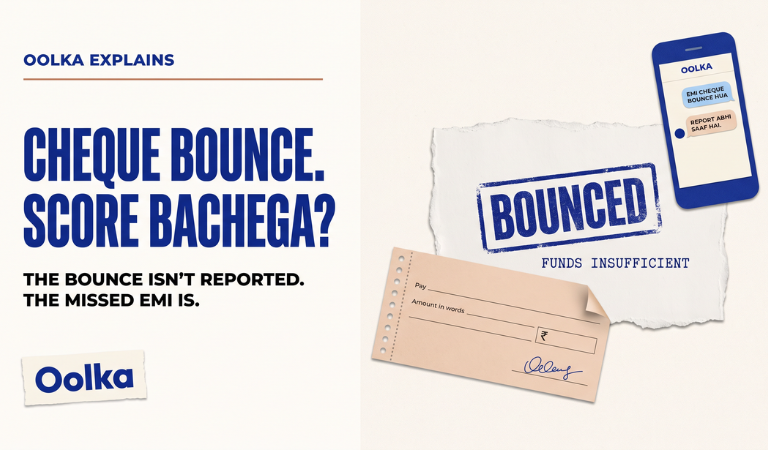
A cheque bounce does not directly reduce your credit score just because the cheque was returned unpaid. The impact starts when the bounced cheque causes a missed EMI, unpaid loan amount, overdue account, or other repayment problem that the lender reports to credit bureaus.
A borrower issues a Rs.48,000 cheque towards a personal loan EMI. The cheque bounces because the account balance is short by Rs.3,000. The borrower pays the EMI two days later and assumes the matter is over. The bank has already charged a cheque return fee, and the borrower wants to know whether the incident will affect their credit score.
The answer depends on what happened after the bounce. Credit bureaus such as CRIF High Mark, Equifax and Experian India receive credit information from lenders. A returned cheque itself is not the same thing as a reported late payment.
Does a Bounced Cheque Directly Affect Your Credit Score?
No. A cheque bounce by itself does not automatically lower your credit score. The important issue is whether the failed payment resulted in an overdue credit obligation that the lender reported to a credit bureau.
Suppose you issue a Rs.20,000 cheque for an EMI and it bounces. If you replace the payment immediately and the lender does not report the EMI as overdue, the cheque bounce itself does not create a negative credit entry.
The situation changes if the bounced cheque leaves the EMI unpaid. A lender could then record the missed payment according to its reporting process. This distinction matters because a cheque is a payment method. Your credit report records credit behaviour reported by lenders, not every transaction that fails in your bank account.
So a bounced cheque is rarely the problem on its own. What matters is whether it left a credit payment unpaid.
What Happens When an EMI Cheque Bounces?
When an EMI cheque bounces, the first problem is the failed payment. The lender can charge a return fee, present the payment again, request another payment method, or treat the EMI as overdue according to the loan agreement.
For example, imagine a Rs.25,000 EMI due to Tata Capital. You issue a cheque, but it is returned because the account does not have enough funds. If you immediately pay Rs.25,000 through another permitted method and the lender records the EMI as paid without an overdue entry, the credit impact is different from leaving the EMI unpaid for several days.
The same principle applies to loans from Bajaj Finserv, IIFL, HDFC Bank or other lenders.
| Situation | Possible Credit Consequence |
| Cheque bounces but EMI is paid immediately | No automatic score reduction |
| Bank charges cheque return fee | Banking cost, not automatically a credit score issue |
| EMI remains unpaid | Possible overdue reporting |
| Repeated EMI payment failures | Stronger concern for the lender |
| Unpaid loan continues for longer | Negative repayment history |
| Incorrect overdue entry is reported | Dispute and correction may be required |
The payment outcome matters more than the cheque itself.
What If an EMI NACH or ECS Auto-Debit Fails?
An EMI can also fail when a NACH or ECS auto-debit is returned because of insufficient balance, an inactive mandate or a bank-related issue. Like a bounced cheque, a failed auto-debit does not automatically reduce your credit score. The key question is whether the EMI remains unpaid and the lender reports it as overdue.
Pay the outstanding EMI through an accepted method and confirm that the lender has recorded the payment correctly. Also check whether a failed debit has triggered additional bank or lender charges. For more details, read EMI Bounce Charges: Costs, Consequences and Prevention.
Will a Bounced Cheque Show Up in Your Credit Report?
A bounced cheque does not automatically appear as a separate negative entry simply because the bank returned it unpaid. Credit reports focus on credit accounts and repayment information supplied by reporting institutions.
If a cheque was used to repay a personal loan from SBI and the payment failed, the lender’s subsequent reporting is what matters. If the EMI is recorded as overdue, that repayment information could appear in the credit report.
The same applies to a home loan, car loan, consumer loan or credit card payment made through a cheque. The payment instrument and the credit account are separate things.
Many people ask, “will cheque bounce affect credit score?” Not by itself. It is best to check the actual loan account after the incident. Look for overdue status, days past due, outstanding amount and repayment history rather than assuming the returned cheque itself caused a score change.
Before worrying about your score, see what the lender actually reported. Oolka lets you check your report for free and takes over the dispute and lender communication when you need to challenge an incorrect entry.
How Much Can a Cheque Bounce Change Your Credit Score?
There is no fixed number of points that a cheque bounce reduces. A lender does not report a standard deduction such as 10, 20 or 50 points for every returned cheque.
The effect depends on what the bounce leads to. One returned cheque followed by immediate repayment is different from an unpaid EMI that remains overdue and is reported by the lender.
Your credit score also reflects other reported factors, including repayment history, outstanding debt, credit utilisation where applicable, account age and recent enquiries.
A common way to read the score helps you quickly determine where you stand:
- 300 to 549: Low
- 550 to 649: Moderate
- 650 to 749: Good
- 750 and above: Very good
Lenders also use their own eligibility rules. A credit card application could have a different threshold from a personal loan, while a home loan usually involves stricter assessment. A score of 750+ is generally considered strong, but approval is never based on the score alone.
So, the idea that a bounced cheque will reduce your credit score is not accurate. The repayment record created after the bounce is what needs attention.
How One Bounced EMI Created a Bigger Problem
A borrower had a Rs.6.5 lakh personal loan with a monthly EMI of Rs.21,400. One month, the cheque issued for the EMI bounced because the salary had not been credited to the account on time. The borrower transferred the EMI as soon as the salary came in and assumed the issue was settled.
A few months later, while applying for another loan, the borrower checked their credit report and noticed an overdue entry for the month when the cheque had bounced. Although the EMI had been paid, the repayment information on the report did not reflect what had actually happened.
The issue was no longer the bounced cheque itself. It was the incorrect repayment entry that needed to be challenged.
If an entry like this is wrong, Oolka can take it on:
- Oolka files a dispute against the incorrect repayment entry.
- It drafts the lender email explaining the payment and includes the available transaction evidence.
- Oolka follows up with the lender on the correction request.
- It continues the dispute process until the reported information is addressed.
This is why the first step after a bounced EMI should be checking what happened to the underlying loan account. If the payment was made but the credit information is wrong, the incorrect entry needs to be challenged.
How Should You Recover After a Cheque Bounce?
Start by clearing the underlying payment quickly. Keep the bank confirmation, payment receipt, cheque return memo and lender communication because these documents establish what happened and when the amount was settled.
If the cheque was for an EMI, confirm that the lender has received the replacement payment. Do not assume that paying the amount automatically removes an overdue entry if one has already been reported.
You should also review your credit report after the issue has been resolved. If you find an incorrect overdue status or repayment entry, raise the issue with the lender and the relevant credit bureau.
For people searching “how to improve credit score”, the practical answer is: focus on consistent repayment behaviour. Pay EMIs on time, avoid leaving loan instalments unpaid, keep credit card balances under control and address incorrect reporting instead of letting it remain unresolved.
If a complaint about your credit report isn’t resolved within 30 days of filing it, you’re entitled to Rs.100 for every day of delay.
Do not wait for an incorrect overdue entry to become a bigger loan problem. Check your report, identify what was actually reported, and let Oolka handle the dispute and lender follow-up when action is needed.
The Bottom Line: Does a Cheque Bounce Hurt Your Credit Score?
A returned cheque does not automatically reduce your credit score. The real credit risk begins when the failed cheque results in an unpaid EMI, overdue loan amount or negative repayment information reported by the lender.
Pay the amount quickly, keep proof of settlement and check the relevant loan account. If incorrect repayment information appears in your report, challenge it rather than assuming the entry will disappear on its own.
A single payment failure does not define your credit history. What matters is how the underlying debt is handled and what information the lender ultimately reports.
Also Read: Credit Line on UPI: How It Affects Your Credit Score
FAQs
1. Does a cheque bounce directly affect my credit score?
No. A returned cheque itself does not automatically reduce your credit score. The impact arises when it leads to an unpaid EMI, overdue loan amount or negative repayment information reported by the lender.
2. Will a bounced cheque show up in my credit report?
The cheque bounce itself is not automatically listed as a separate credit-report entry. If the failed payment causes an overdue amount on a loan or credit account, the lender’s reported repayment information could appear in your report.
3. What happens if my EMI cheque bounces?
The lender could charge a cheque return fee and ask for another payment. If the EMI remains unpaid, the account could become overdue and the lender could report the repayment status to credit bureaus.
4. How many credit-score points does a cheque bounce reduce?
There is no fixed number of points deducted for a cheque bounce. The effect depends on whether the incident results in overdue repayment information and how that information affects the overall scoring factors in your report.
5. What is the legal consequence of a cheque bounce in India?
Section 138 of the Negotiable Instruments Act provides a legal route for certain cheque dishonours involving legally enforceable debt or liability. If the statutory conditions are satisfied, the matter could lead to prosecution, with punishment including imprisonment, a fine, or both.
6. Can one cheque bounce, if resolved quickly, avoid hurting my credit score?
Yes. If the payment is replaced quickly and the lender does not report an overdue repayment against the credit account, the returned cheque does not automatically create a negative credit entry. Keep proof of payment and check your report if you later notice an incorrect entry.