
Loan application rejected. Score looked fine. Still blocked.
Pooja, 31, from Pune, applied for a Rs. 6 lakh business loan. Salary stable. Existing EMIs under control. Still rejected. Reason: “Suit-filed account.”
She had ignored an old loan dispute years ago after missing payments during a job switch. She assumed the account had become inactive. It hadn’t.
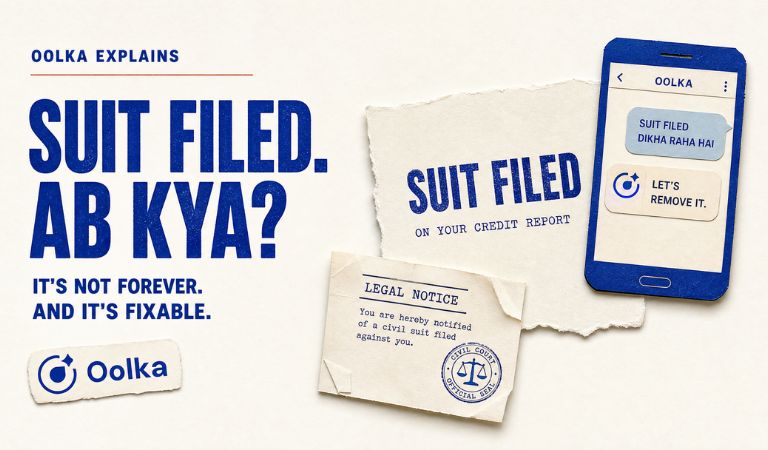
Suit filed means the lender has taken legal action to recover unpaid dues. It stays in your report and affects approvals.
What Does Suit Filed Mean?
A suit-filed entry in a CIBIL report means the lender has initiated legal action against the borrower because of unpaid dues or prolonged default.
In simple terms, if payment does not occur after a considerable period and if the debt is not recovered despite several attempts, the lender may pursue the case legally.
This is what people refer to as suit filed meaning in CIBIL.
The entry appears in the credit report to indicate that the account has reached a legal recovery stage.
Why Does a Suit Filed Status Appear?
A suit-filed status usually appears due to missed repayments or unsuccessful efforts in retrieving the amount. Some causes are:
- Long-term EMI defaults
- Ignoring lender notices
- Unpaid credit card balances
- Loan disputes left unresolved
- Settlement failures
Once legal proceedings begin, the account may be marked as suit filed CIBIL or CIBIL suit filed in the report.
This status usually appears only after the lender has already attempted reminders, follow-ups, or recovery communication multiple times.
Unresolved dues continue to go through the process of recovery, and they may ultimately be entered into the legal stage. This is where the suit-filed entry on the report starts having more impact on the approval process going forward.
Also Read: What is LSS in CIBIL and How Does It Affect Your Credit Score?
Common Legal Processes Linked to Suit Filed Accounts
Civil Recovery Proceedings
Banks and NBFCs may initiate civil recovery action to recover unpaid dues. This generally happens in larger unpaid loan accounts where repeated recovery attempts have failed.
Once legal recovery starts, the account may be reported as suit filed in the CIBIL report.
DRT (Debt Recovery Tribunal) Cases
For larger loan defaults, especially business or secured loans, lenders may approach the Debt Recovery Tribunal (DRT).
DRT cases are more commonly associated with:
- Business loans
- Secured lending
- Higher outstanding amounts
When recovery escalates to this level, lenders usually treat the borrower profile as significantly high risk during future underwriting.
Section 138 Proceedings
In some repayment disputes involving bounced repayment cheques, lenders may also proceed under Section 138 of the Negotiable Instruments Act.
This usually applies when:
- EMI cheques bounce repeatedly
- Settlement cheques fail
- Payment commitments are dishonoured
Although the legal process differs from standard recovery suits, repeated cheque bounce cases may still affect lender confidence and account reporting.
How Different Lenders React to Suit Filed Accounts
Not every lender evaluates suit-filed accounts the same way.
- Public sector banks may apply stricter underwriting checks
- NBFCs may review repayment behaviour after settlement
- Fintech lenders may reject applications automatically
- Secured loan lenders may examine closure proof before approval
Written-Off vs Suit Filed: What’s the Difference
| Status | Meaning | Risk Level |
| DPD Entries (030/060/090) | Consecutive delayed payments reflected in the report | Moderate |
| Settled | Loan closed after partial payment | High |
| Written-off | Loan marked as loss | Very High |
| Suit Filed | Legal recovery initiated | Severe |
This is how lenders evaluate CIBIL suit filed cases during underwriting.
Real Story: One Old Account, Multiple Rejections
Aakash, 37, Hyderabad.
Starting point: Score 721. Two loan rejections.
Reason: Personal loan incorrectly reported as suit filed.
The loan had already been resolved years earlier, but the legal recovery status was still reflecting in the report during underwriting checks.
He assumed the issue was connected to his score. It wasn’t.
What happened next:
- Day 1: Full credit report reviewed after repeated rejections
- Week 1: The outdated suit-filed status was identified in the account history
- Week 2: Supporting repayment and closure records were matched against the report
- Month 1: A dispute was raised for incorrect reporting and status mismatch
- Month 2: The lender updated the account and the report reflected the corrected status
Result: The next loan application moved forward without the earlier rejection issue.
Lesson: Even resolved accounts can continue affecting approvals if incorrect legal recovery status still appears in the report.
How Does a Suit Filed Status Affect Your Credit Profile?
A suit-filed entry impacts more than just the score.
It can lead to several major issues such as:
- Loan rejection
- Higher interest rates
- Lower approved amount
- Extra verification checks
- Difficulty getting unsecured credit
Even after repayment, lenders may still review the account history carefully.
That is why understanding how to improve CIBIL score alone is not enough if serious negative entries still exist in the report.
A suit-filed entry signals that the account reached legal recovery at some point, which increases perceived lending risk.
During larger loan applications such as home loans or business loans, lenders often examine these entries more closely before approving fresh credit or deciding the final loan terms.
Can a Suit Filed Status Be Removed?
Yes, but only in certain situations.
If the entry is correct, repayment is required first. After settlement or closure, the lender may update the status based on the account resolution.
If the entry is incorrect, outdated, or already resolved but still showing incorrectly, correction requests can be raised.
This is where people search for how to remove suit filed in CIBIL or how to remove loan from CIBIL.
How Should You Handle a Suit Filed Account?
The process depends on the account status.
If dues are pending:
- Check the outstanding amount
- Speak with the lender
- Clear or resolve the dues
- Collect closure proof
If reporting is incorrect:
- Review the report carefully
- Match repayment records
- Raise a correction request
- Track updates until corrected
The problem ignored usually makes things more difficult in the future.
Many borrowers do not realise an old unresolved account has already reached the legal recovery stage.
Oolka scans the full credit report and brings suit-filed loan accounts into focus early, including the linked loan status, repayment stage, and account activity reflected in the report. Check your report on Oolka today.
What Happens When Suit Filed Accounts Are Checked on Oolka
Suit-filed entries are often missed because most people only check the score.
Here’s what actually happens:
Step 1: Oolka scans the full credit report and identifies suit-filed accounts
Step 2: It checks whether the reporting matches the repayment history
Step 3: It flags incorrect, unresolved, or outdated entries
Step 4: It prepares the correction flow required for the account
Step 5: It tracks updates until the report reflects the corrected status
Borrowers become aware of this problem only when their applications get turned down. This helps them identify the problem early on.
Also Read: How to Secure a Personal Loan with a CIBIL score of 550
What Mistakes Make a Suit Filed Status Worse?
- Ignoring lender notices
- Assuming old accounts disappear automatically
- Applying for multiple loans without fixing the issue
- Settling without checking report updates
- Never reviewing the full credit report
These errors result in the negative records remaining active for longer.
In many cases, borrowers become aware of these problems through repeated denials or additional verification checks from lenders. At this point, it becomes time-consuming to rectify the report. Rather than just focusing on the credit score, you should review the entire report regularly.
The Bottom Line: Suit Filed Status in CIBIL
Suit-filed status means legal recovery action has started because of unpaid dues.
Things you should know:
- Suit filed is considered a serious negative entry
- It affects approvals along with lender trust
- Repayment alone won’t be sufficient to instantly remove history
- It is possible to fix incorrect reporting
- Checking the full report matters more than checking only the score
If approvals are getting delayed despite a decent score, this could be one of the reasons.
Oolka identifies suit-filed accounts affecting approvals. Surfaces the report details linked to unresolved or closed loan accounts and tracks status updates after the account is resolved.
FAQs
1. What is suit filed in CIBIL report?
It means the lender has initiated legal proceedings against the borrower because of unpaid dues or prolonged default.
2. How does a suit-filed status affect your credit score?
It adversely affects your credit profile and is an indication of high-risk behaviour to the lender, which makes it hard for future loans to be approved.
3. Can a suit filed status be removed from the CIBIL report?
It cannot be removed if reported correctly, but it can be updated after resolution or corrected if inaccurate.
4. How to remove suit filed in CIBIL?
You need to resolve the dues first and then ensure the lender updates the account correctly in the credit report.
5. How long does a suit filed remain in the credit report?
It might stay on the report for several years depending on bureau reporting times and account resolution.
6. Can I get a loan with a suit filed status?
It is feasible to secure the loans, but getting approval will be challenging since suit-filed accounts are perceived as risky.
7. Can a suit-filed status impact future loan approvals?
Yes. Even after repayment, lenders may still review the account history before approving fresh credit.