
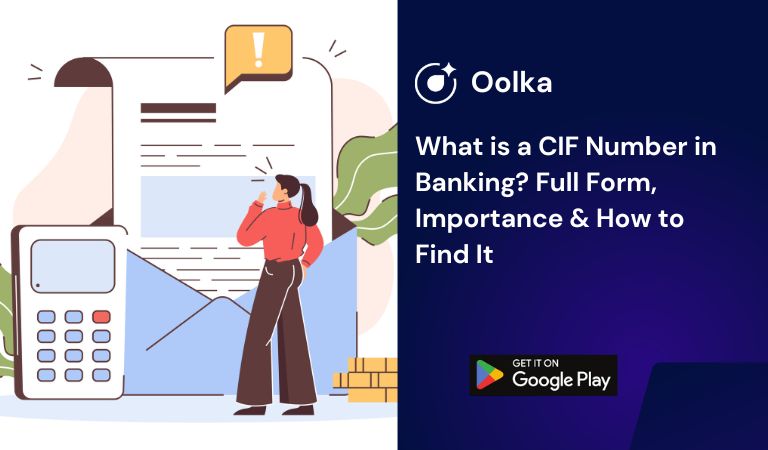
Every bank customer gets a special ID number that connects all of their accounts, services, and transactions with the bank. The CIF Number is what this number is called. The CIF is like a digital fingerprint for people who utilize the bank’s services. It’s like an Aadhaar number for consumers. Because all of your accounts, loans, and services are linked to one profile, it’s easy to keep track of and manage everything. Customers might be able to keep better track of their money if they know what a CIF number is and how it operates.
What is a CIF Number and its Full Form in Banking?
The term “CIF Number” stands for “Customer Information File Number”. Banks give each customer a unique numerical code that is usually between 8 and 11 digits long. The bank has all the information about the customer that this number shows.
The CIF keeps track of a variety of information, such as personal information, account type, balance history, loan records, credit card relationships, and even KYC (Know Your Customer) data. The bank uses the CIF to create a single digital identity for you instead of retaining separate records for each service or account. If you have a savings account, a fixed deposit, and a home loan with the same bank, all of them are linked to the same CIF number. This enables the bank to look into your financial history, keep track of your transactions, and give you services that are right for you.
Importance of a CIF Number
Unique Customer Identification
The CIF number makes sure that every customer has a unique identity in the bank’s system. The CIF offers each customer a different code so that there is no mix-up, even if two customers have the same name. This is especially important for big banks that have millions of customers.
Keeps Track of All Accounts
Your CIF number brings together all of your accounts, such as your savings account, fixed deposit, recurring deposit, loans, and credit cards, into one profile. This one view makes it easy for you and the bank to keep an eye on your spending and account activities.
Secure Transactions in Banking
By bringing together consumer data, the CIF number makes transactions safer and less likely to go wrong. It’s easy for banks to find out who owns an account and what it has done in the past. This decreases the risk of fraud and makes sure that the proper consumer gets the right services.
Needed for Digital Banking Services
Many banks may ask for your CIF number when you sign up for online banking, mobile banking, or other digital services. It binds all accounts together, which makes it a key point of reference for turning on and running these services smoothly.
How to Find Your CIF Number
How to use Bank Passbook
The first page of the passbook at most banks has the CIF number and other account information, like the account number, IFSC code, and branch address. Most of the time, it states “CIF No.” or “Customer Information File Number.”
On the Cheque Book
The CIF number is normally on the first page or the page with the account data in a cheque book. For people who write cheques, it’s a quick reference.
Using Online Banking
Find the account summary or profile area on your bank’s website. You may find your CIF number and account details here. Some banks might also show it in the e-statement section.
Apps for banking on your phone
You can discover the CIF number by opening your bank’s mobile app and heading to your account details or profile settings. Many apps also have it under the “Customer Details” or “My Account” section, where you can quickly discover it.
By heading to the bank branch
If you can’t find your CIF number in any digital or physical documents, you can go to your home branch. A bank worker would give it to you after validating your identity with KYC documents like your Aadhaar or PAN.
Difference between CIF Number and Account Number
Scope and Usage
The CIF number is used to put all of a customer’s financial relationships into one profile and keep track of them. It has savings accounts, fixed deposits, loans, credit cards, and other things. An account number, on the other hand, is unique to one account at the bank, like a savings account or a current account.
Uniqueness
No matter how many accounts or services a consumer has, they only have one CIF number per bank. But a customer might have more than one account number, and each one stands for a different financial product. For instance, a person might have three separate account numbers but only one CIF with the bank.
Security Aspects
Banks generally use the CIF number to identify themselves internally. It can be shared with the consumer, but it is not utilised directly for transactions. The account number, on the other hand, is a transactional identification that is used for deposits, withdrawals, and transfers. This makes account numbers more vulnerable, although CIF numbers are still very safe inside bank systems.
Common Issues Related to CIF Number
Forgotten or Misplaced CIF Number
People typically forget their CIF number because they don’t use it every day. You may simply get it back if you lose it by using the passbook, the chequebook, the mobile banking app, or going to the bank branch. This is still a pain, especially when you need to sign up for new services or set up online banking.
Multiple Accounts with Different Banks
If you have accounts at more than one bank, you will have more than one CIF because each bank provides you its unique CIF number. This can be challenging to understand, especially if you have to keep track of more than one loan or deposit because you have to write down each CIF separately.
Errors in Linking Accounts
Sometimes, due to technical problems or missing KYC updates, it may not be feasible to link more than one account at the same bank to a single CIF number. This can cause profiles to break up, approvals to take longer, or make it impossible to get to services that are combined, such as online banking.
FAQs on CIF Number in Banking
Is CIF number the same for all accounts in a bank?
Yes. Each bank gives a customer a unique CIF number that connects all of their accounts and services.
Can I have more than one CIF number at the same bank?
No. In a perfect world, each bank would only give one CIF number to each customer. The bank can combine numerous CIFs if they were created by mistake.
Is the CIF number confidential?
Yes. The CIF number is an internal identification that clients can see, but it shouldn’t be shared unless it’s absolutely necessary to avoid misuse of personal banking information.
Do I need a CIF number to use internet banking?
No. The CIF number is normally needed when you sign up for internet or mobile banking because it combines all of your accounts.
What does the CIF number do to help with loan processing?
Banks look at your CIF profile to see your general financial history, deposits, and credit behaviour. This helps them decide if you can get a loan and how risky it is to provide you one.
Will my CIF number change if I move to a different branch?
No, the CIF number stays the same even if you move your account to a different branch of the same bank.
How do I change the information on my CIF number?
You can change your address, phone number, or email by sending your bank branch or digital channels updated KYC documentation. Not the CIF itself, but the data stored in it changes.